
Some links in this article are affiliate links. As an Amazon Associate, rcplanediy.com earns from qualifying purchases at no extra cost to you.
If you’ve ever had a motor suddenly go from screaming full throttle to completely dead mid-flight, congratulations — you’ve met your ESC at its worst. The Electronic Speed Controller is basically the traffic cop between your battery and your motor, and when it fails, there’s really nothing else in the whole power chain that matters anymore. You’re gliding. Or tumbling. Depending on the day.
I’ve blown through a few ESCs over the years. Some of those were my fault (yeah, I underspecced a 6S build once, won’t be doing that again). Some were just cheap junk that gave up after a couple of sessions. The point is, picking the right ESC for your airplane isn’t just about checking a current rating off a list — it’s about matching the controller to your motor, your battery cells, your aircraft type, and having enough headroom that the thing doesn’t cook itself the moment you do a few WOT passes.
This guide covers ESCs from budget park flyer stuff all the way up to serious power systems for large scale builds, organized by use case, in order to choose the best esc for your airplane. Whether you’re wiring up a foam trainer on 3S, or running a gas-equivalent brushless on 6S in a 90″ warbird, there’s something in here for you.
Also, if you’re still figuring out your full power system, check out our guides on best brushless motors for RC airplanes, best LiPo batteries, and best propellers for RC airplanes — those go hand-in-hand with ESC selection.
⚡ Quick Picks at a Glance
- Best Overall / Mid-Range Workhorse: Hobbywing Skywalker 40A V2
- Best Budget for Trainers: TOYTENSI 40A Fixed-Wing ESC
- Best for Serious Builds with Telemetry: Spektrum Avian 60A Smart ESC
- Best Micro / Park Flyer: Hobbywing Skywalker 20A V2
- Best High-Power / Giant Scale: Castle Creations Talon 60
- Best for EDF Jets: Hobbywing Skywalker 80A V2
What to Look For in an RC Airplane ESC
Before you just grab whatever’s cheapest with “airplane” in the title, there are a few things worth understanding. A lot of builders — especially coming from quads — get burned on this.
Current Rating (Amps). This is the big one. Your ESC continuous rating needs to comfortably exceed your motor’s maximum current draw. Not match it — exceed it, ideally by 20-30%. If your motor peaks at 35A, you want a 40A or 45A ESC minimum. Running right at the limit generates heat and shortens life considerably.
Cell Count (S-rating). ESCs have a voltage range they can handle, expressed in LiPo cell count. A 2-4S ESC can run 2S (7.4V), 3S (11.1V), or 4S (14.8V) packs. Going over the rated voltage is a one-way trip to parts-ordering territory.
BEC vs. OPTO. Most fixed-wing ESCs include a Battery Elimination Circuit (BEC), which powers your receiver and servos from the main battery — no separate RX battery needed. OPTO ESCs have no BEC and require a separate power source for the RX. For most airplane builds, you want an ESC with a BEC. Just makes life simpler. OPTO makes more sense for high-amp setups where BEC heat is a concern.
Fixed-Wing vs. Multirotor Firmware. This matters more than people think. ESCs tuned for multirotor use have very different throttle curves and timing — not ideal for airplane flying. Look for products that specifically mention “fixed-wing” or “airplane” in their description. The Hobbywing Skywalker series is the classic example of a properly fixed-wing tuned ESC.
Programmability. For sport and larger aircraft, you want to be able to set brake mode (on for gliders, off for most planes), battery cutoff voltage, timing, and soft-start. A programming card or LED box is worth having for any serious setup.
Heat and Build Quality. Cheap ESCs use inferior MOSFETs and caps. They run hotter. Caps leak. Then the whole board corrodes. Brands like Hobbywing, Spektrum, and Castle Creations use better components — and that shows in their longevity. Budget options from TOYTENSI and Flycolor are decent value at the lower power ranges, but I’d be more careful with generic stuff once you’re past 60A.
Section 1 — Budget ESCs: Best Options for Trainers and Park Flyers
If you’re building your first trainer, a 3S park flyer, or just need a replacement that won’t make your wallet sad, these are solid starting points. Nothing fancy, but they work — and at this price, losing one in a crash isn’t a catastrophe.
🥇 1. TOYTENSI 40A Brushless ESC for RC Airplane (Fixed-Wing Specific)
This one gets a lot of quiet love from builders who just want something that works out of the box without drama. TOYTENSI builds this line specifically for RC planes and airplanes, which makes a real difference in how it feels in the air versus a multirotor ESC crammed into a plane.
The 40A rating on 2-4S covers most 3S sport and trainer setups with comfortable headroom, and it still has margin on 4S with a moderate motor. A 32-bit processor gives smooth, accurate throttle response, and the switch-mode BEC is selectable between 5V and 6V at up to 4A, which is more than enough for standard servo loads. XT60 input and 3.5mm gold bullet outputs come pre-attached, so there’s no soldering. You can program it from your transmitter or with the optional LCD program box, and it has the usual protections: power-on, over-temperature, low-voltage cutoff and signal loss.
The thing I’d flag is the documentation, which is… minimal. You kind of need to find a YouTube setup video.
- Specs: 40A | 2-4S LiPo | 32-bit | SBEC: 5V/6V @ 4A | XT60 + 3.5mm
- Best for: 3S trainers, sport foamies, park flyers, first builds

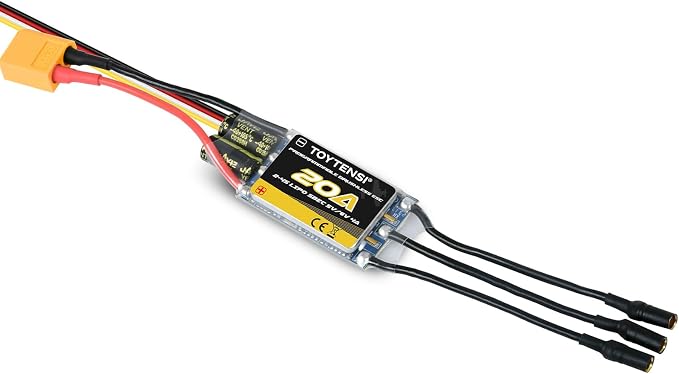
2. TOYTENSI 20A Brushless ESC for RC Airplane
Same family as the 40A but scaled down for smaller aircraft — think foamies in the 800-1000mm wingspan range, micro sport planes, slow flyers. Good option if you’re building something small and light and don’t want an oversized ESC adding weight. Same fixed-wing tuning, same switchable BEC voltage, same pre-soldered plugs. For what it costs, it’s hard to complain.
- Specs: 20A cont / 30A peak | 2-4S LiPo | BEC: 5V/6V @ 4A | 33.6g
- Best for: Mini trainers, small foamies, slow flyers, micro sport aircraft
3. Flycolor 30A ESC for RC Airplane (2-4S)
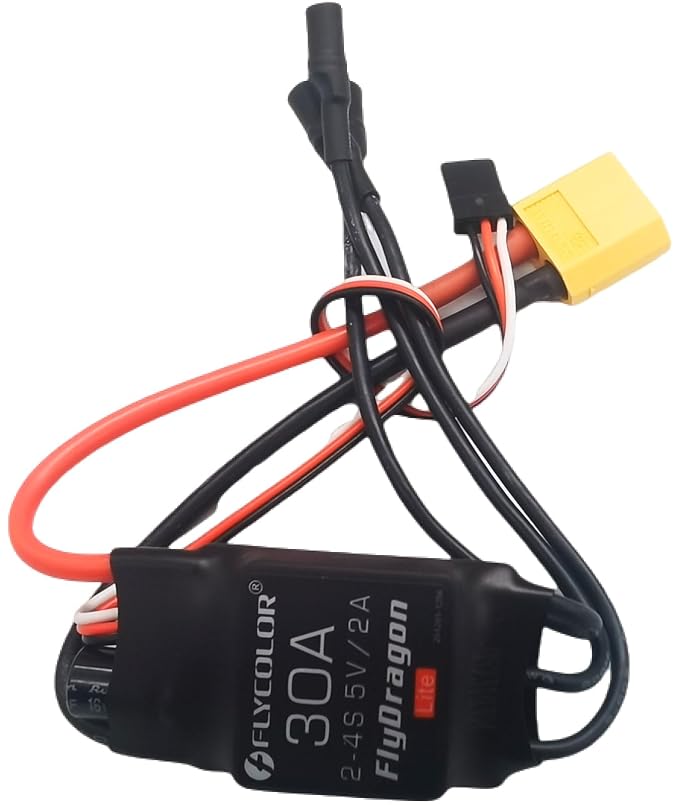
Flycolor is one of those brands that punches above its price point. This FlyDragon Lite 30A covers a good range of 2S–4S builds for small and mid-size sport planes. Comes pre-soldered with XT60 and 3.5mm bullets, it’s small and light, and the throttle response is fast and linear. The low-voltage cutoff threshold and start mode can be set, and it has the usual protections (abnormal start, over-heat, signal loss, low-voltage). It does run off multirotor firmware origins, so throttle feel isn’t quite as airplane-specific as TOYTENSI, but most pilots won’t notice at this level.
One thing to know is that the BEC is only 5V at 2A — fine for 2-3 standard micro or mini servos, but if you’re running digital servos or have a big servo count, you’ll want an external BEC.
- Specs: 30A | 2-4S | BEC: 5V @ 2A | XT60 + 3.5mm | 8-bit C8051 MCU
- Best for: Small to mid-size sport planes, budget 3S builds
Section 2 — Hobbywing Skywalker Series: The Fixed-Wing Standard
Right, so the Hobbywing Skywalker line is basically what everyone recommends when someone asks “what ESC should I get for my airplane?” — and for good reason. These are genuinely fixed-wing optimized: the throttle curve is smooth and linear, the reverse brake feature actually works well for shortening landing rollouts, and the protection suite is solid. You can program them with the LED card (affordable, worth buying) or by transmitter stick.
I run Skywalker ESCs in most of my own builds now. They just don’t give you trouble. The V2 series added a 32-bit processor, improved DEO (driving efficiency optimization) tech that reduces heat, and better multi-protection features. Not the cheapest option but close to it for what you get.
4. Hobbywing Skywalker 20A V2 ESC
The entry point of the Skywalker V2 range. Handles 2-3S which makes it ideal for park flyers and micro trainers up to around 1200mm wingspan. Weighs only 19g — important if you’re weight-conscious on a small build. Throttle response is noticeably smoother than budget alternatives. The reverse brake mode is a nice touch even on small planes.
Downside: 2-3S only, so you can’t take it to a 4S setup if you later upgrade. Also the BEC is linear mode at 5V/3A — fine for this size of aircraft but something to note.
- Specs: 20A cont / 40A peak | 2-3S | BEC: 5V @ 3A (linear) | 19g
- Best for: Park flyers, micro trainers, lightweight foamies on 2S-3S

🥇 5. Hobbywing Skywalker 40A V2 ESC — Best Overall Pick
This is the ESC I’d hand to most builders looking for a reliable mid-range option. The 40A / 60A peak at 3-4S covers the most popular airplane power systems — from 1200-1600mm sport planes to lighter scale aircraft. Switch-mode BEC at 5V/5A handles digital servos without complaint. The 32-bit ARM processor gives you snappy throttle response and stable RPM maintenance through maneuvers.
Programming through the LED Program Box is straightforward once you’ve done it once (the manual is actually decent). The reverse brake is genuinely useful — set it to soft brake for most planes, and it really does shorten your ground roll on landing. Some builders leave brake off entirely for pusher setups or planes that use prop wash for pitch authority at slow speed.
The 40A is the sweet spot of the range. Not so small that you’re constantly worried about thermal cutoff, not so large that you’re paying for headroom you’ll never use on a mid-sized build.
- Specs: 40A cont / 60A peak | 3-4S | BEC: 5V @ 5A (switch) | 36g
- Best for: 1200-1600mm sport planes, scale aircraft, general-purpose mid-size builds

6. Hobbywing Skywalker 60A V2 ESC
Step up from the 40A for larger or more power-hungry aircraft — think 1600-2000mm wingspan sport planes, aerobatic models on high-Kv setups, or anything pulling more than 40A consistently. Switch-mode BEC at 5V/5A, same 32-bit processor, same solid protection suite. Works from 2-6S which gives you a lot of flexibility for future builds.
Not a lot of obvious flaws here honestly. It’s heavier than the 40A at 63g, which matters on lighter builds but is irrelevant on anything 1600mm and up. Some people find the programming box an extra cost to factor in — fair point, it’s sold separately.
- Specs: 60A cont / 80A peak | 2-6S | BEC: 5V @ 5A (switch) | 63g
- Best for: Large sport planes, 4S+ aerobatic models, 1600-2000mm wingspan aircraft

7. Hobbywing Skywalker 80A V2 ESC
This is where you go for EDF jets on 4-6S or big warbirds with large diameter props and high-KV motors. 80A continuous with 100A peak covers a lot of ground. The BEC steps up to 7A which is important when you’re running 5+ servos in a large-scale aircraft. The 2-6S range makes it compatible with everything from 4S sport setups to 6S performance builds.
EDF flyers take note — this is specifically one of the recommended ESCs for 70mm and 80mm fan units. The high refresh rate (up to 432Hz) means motor response is quick enough for the high-RPM demands of ducted fans.
- Specs: 80A cont / 100A peak | 2-6S | BEC: 5V @ 7A (switch) | weight ~79g
- Best for: EDF jets 70-80mm, large warbirds, high-power 5S-6S builds

Section 3 — Spektrum Avian Smart ESCs: The Telemetry Option
If you’re flying with a Spektrum radio (DX6 and above, or any iX-series), the Avian Smart ESC ecosystem is genuinely impressive and worth knowing about. These ESCs transmit real-time telemetry back to your transmitter — current draw, RPM, ESC temperature, battery voltage, cell balance — over a single wire, no extra sensors needed. You can actually watch your pack drain in real time on your TX screen, which is surprisingly useful once you’ve experienced it.
The premium is real though. You’ll pay more for an Avian 60A than a Skywalker 60A. Whether that premium is worth it depends entirely on your setup. If you’ve got a Spektrum Smart ecosystem (Smart batteries + Smart charger + Smart TX), it all integrates beautifully and you get the most out of the telemetry. If you’re on FrSky or Flysky, there’s no point paying that premium.
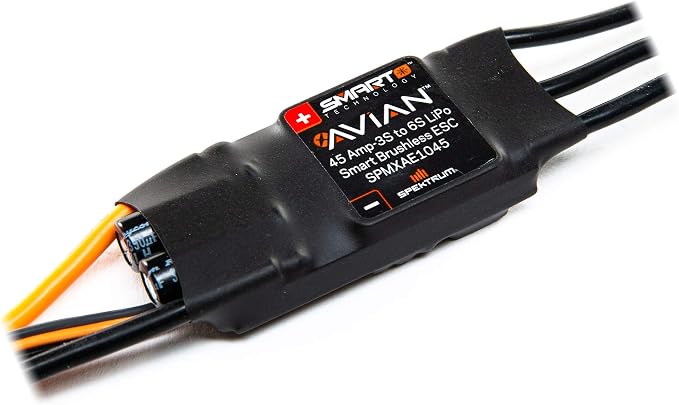
8. Spektrum Avian 45A Brushless Smart ESC (3S-6S)
Good mid-size option for 1300-1600mm wingspan aircraft on 3S-4S, or smaller planes on 5S-6S where you need the voltage headroom. No soldering required (ready-to-install), IC3 connector on the battery side. Programming options are plentiful — throttle stick, Smart ESC Programming Box, or SmartLink USB. The 32-bit ARM M4 processor handles response well.
The main limitation here is the IC3 connector — if you’re not already in the Spektrum ecosystem, you’ll be swapping connectors. Minor annoyance but worth knowing upfront.
- Specs: 45A cont | 3S-6S | Dual BEC | IC3 connector | Smart telemetry
- Best for: Spektrum ecosystem builds, 1300-1600mm aircraft, pilots who want telemetry data
🥇 9. Spektrum Avian 60A Brushless Smart ESC (3S-6S) — Best Premium Pick
The 60A Avian is the most popular size in the Smart line for intermediate to large aircraft. Covers a wide variety of builds from performance 4S sport planes all the way to 6S scale models. The IC3 version works with most modern Spektrum Smart batteries. Real-time telemetry over one wire gives you current, voltage, temperature and RPM without any extra hardware.
It’s not just gimmicks either — being able to see your motor temp spike on a hot day during a vertical climb before the ESC decides for you is actually useful. Motor reverse is included (useful for some ground handling tricks on twins, or simulator-style braking). Firmware updatable via SmartLink. Compact form factor given the power rating.
The price is legitimately higher than HobbyWing. If you’re on Spektrum, it’s probably worth it. If not, the Skywalker 60A V2 does essentially the same job for less.
- Specs: 60A cont | 3S-6S | Smart telemetry | IC3 | Motor reversing | Firmware updatable
- Best for: Spektrum ecosystem pilots, scale aircraft, telemetry users, performance 4S-6S builds

10. Spektrum Avian 80A Brushless Smart ESC (3S-8S)
The 80A Smart extends the voltage ceiling to 8S, which puts it in territory for high-performance EDF jets and large turbine-equivalent electrics. The higher amp rating combined with the telemetry system is genuinely useful at this power level — you really do want to monitor temps and current on a 8S system. Same IC5 connector as the larger Smart batteries.
This one sits in a fairly specialized bracket. If you’re building a large EDF jet on 6S-8S and you’re on Spektrum, this makes a lot of sense. Outside that use case, the price is hard to justify over a Hobbywing or Castle option.
- Specs: 80A cont | 3S-8S | Smart telemetry | IC5 | Motor reversing
- Best for: Large EDF jets on 6S-8S, giant-scale performance aircraft, Spektrum system integrations

Section 4 — Castle Creations Talon Series: For When You Mean Business
Castle Creations is a US brand with a reputation for being basically indestructible. The Talon series has been around for ages, used by serious pilots in competition aircraft, scale warbirds, helicopters, and anything else where you cannot have the ESC die on you. They’re not the cheapest option in the room — not even close — but the build quality is very different from budget alternatives. The BECs on Castle ESCs are also notably heavy-duty, which matters if you’re running multiple high-torque digital servos.
Castle Link USB adapter (basically free with a coupon that comes in the box) lets you configure everything from a Windows PC. The diagnostic features are excellent — power system alerts via motor beep codes, real-time data logging if you add a telemetry link.
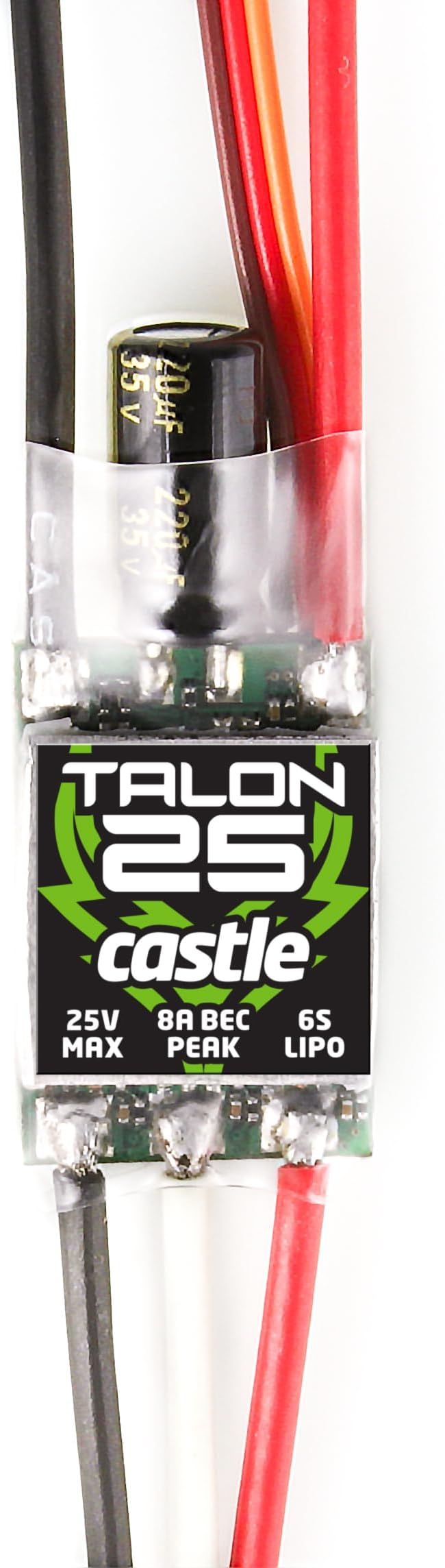
11. Castle Creations Talon 25 (25A, 6S, Heavy BEC)
Compact and surprisingly powerful for its size. The standout spec is the BEC — 8A peak, 3A continuous at 5.5V. That’s comically high for a 25A ESC, but it means your servos will never brown out even if you’re pulling serious current through a digitals-heavy setup. Suited for 3D foamies, 400-size applications, and lightweight sport planes. Programming through Castle Link on PC gives you a ridiculous level of tuning access.
The caveat is you’ll need to add your own connectors — Castle ships them without bullet connectors on the output side to keep things flexible. Adds a step to the build but it’s fine if you solder.
- Specs: 25A cont | 2S-6S | BEC: 8A peak / 3A cont @ 5.5V | 17.9g | Castle Link programmable
- Best for: 3D foamies, 400-size sport aircraft, builds needing robust BEC
🥇 12. Castle Creations Talon 60 (60A, 6S, Heavy BEC) — Best High-Power Pick
This is where Castle really shines. The Talon 60 handles up to 1400W on 6S, which covers a wide range of scale, aerobatic, and warbird aircraft in the .32-.60 engine equivalent range. The BEC pumps 20A peak / 8A continuous — you can run literally any servo combination you want without a separate RX power supply. Governor mode (via Castle Link) is a useful feature if you’re doing helicopter conversions or want precision RPM control.
The thin profile mounting is easy to work with in most airframes. Weight is reasonable given the amp rating. Some builders report this runs slightly warmer than Hobbywing alternatives at sustained high current, but it’s never been a failure point in my experience — it just gets warm and keeps going.
- Specs: 60A cont | up to 6S | BEC: 20A peak / 8A cont @ 5.5V | Castle Link programmable | Data logging with telemetry link
- Best for: Scale warbirds, aerobatic planes, .32-.60 size equivalents, builds needing maximum BEC capacity
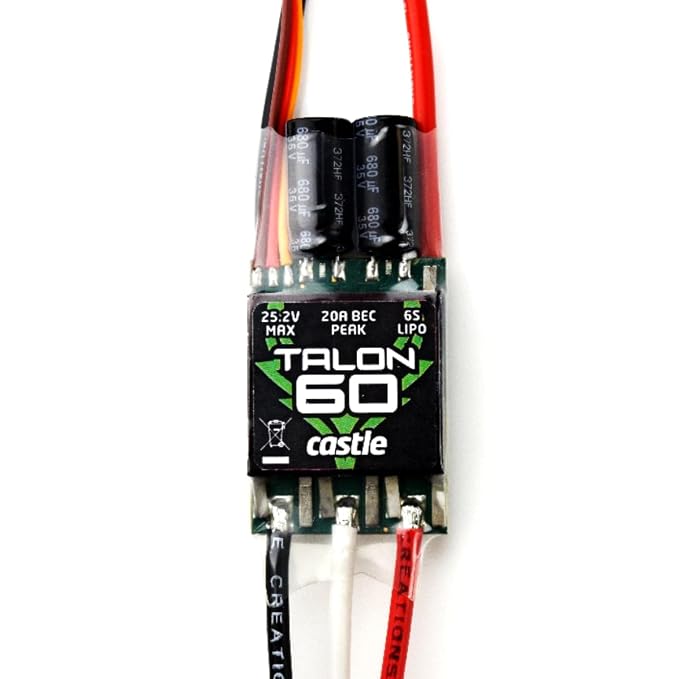
13. Castle Creations Talon 90 (90A, 6S, Heavy BEC)
Top of the Talon aircraft-focused range. 90A continuous with up to 2000W on 6S — puts this in territory for large aerobatic aircraft over 10 lbs and scale ships up to around 20 lbs. Same Castle BEC excellence, same Castle Link programmability. The BEC on this one does 20A peak / 9A continuous. Honestly if you need 90A for a fixed-wing build, you already know what you’re doing and you’re probably not surprised by the price.
Worth noting: some people use this in big scale build applications specifically because of the BEC output — running retracts, high-torque flap servos, lighting systems, all from one ESC cleanly.
- Specs: 90A cont | up to 6S | BEC: 20A peak / 9A cont | Castle Link | full telemetry support
- Best for: Giant scale electric, aerobatic aircraft over 10 lbs, large warbirds

Section 5 — High-Amp ESCs for Large Scale and EDF Jets
Once you’re into the 100A+ territory, you’re generally talking about giant-scale builds, high-performance EDF jets, or twin-engine setups. The Hobbywing Skywalker extends into this range cleanly, and the Spektrum Avian 130A is a genuine option for the Spektrum ecosystem crowd.
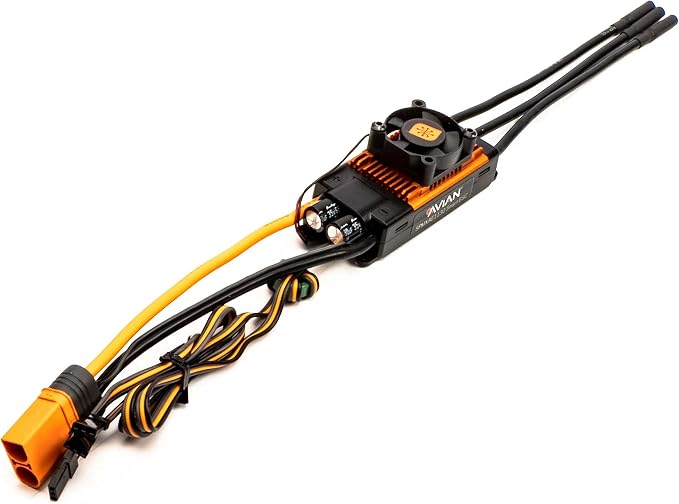
14. Hobbywing Skywalker 120A 8S V2 ESC
This is a proper big-boy ESC. 120A continuous, 8S capable — that’s the kind of hardware going into large EDF jets and giant scale electric builds. The 32-bit ARM M4 processor (running at 120MHz) gives it the headroom to handle high-frequency motor demands. BEC output at 5V/7A handles even complex multi-servo systems. All the Skywalker safety features scale up here: thermal protection, over-current, signal loss failsafe.
Worth noting that at this power level, thermal management matters more. Make sure you have airflow over the ESC — some pilots add a small heatsink or direct a bit of cooling air. Not a knock on the product, just physics.
- Specs: 120A cont | 2-8S | BEC: 5V @ 7A | 32-bit ARM M4 @ 120MHz | 120g approx
- Best for: Large EDF jets, giant scale builds, twin/quad-motor setups
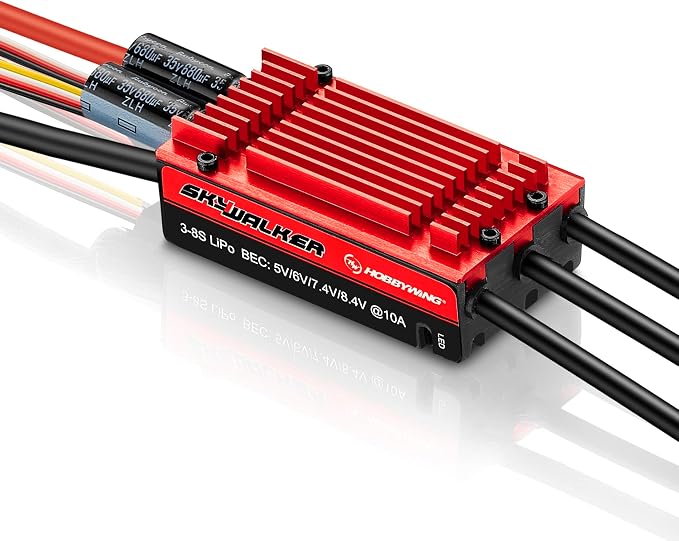
15. Spektrum Avian 130A Brushless Smart ESC (3S-6S)
The biggest Avian in the standard lineup. 130A continuous is serious power for a fixed-wing aircraft. All the Smart telemetry features carry over — real-time current, voltage, RPM, temperature to your Spektrum TX. Dual BEC connectors, IC5 connectors, firmware updatable. This is essentially the choice for Spektrum pilots building the largest electric aircraft in their fleet — big twins, large EDF jets, giant scale warbirds.
Similar to the comment on other Avian units: you’re paying a Spektrum premium. Hobbywing’s 120A Skywalker is a more economical alternative if you don’t need the Smart ecosystem features. But if you do — and you’ve got the rest of the Smart stack — the integration is genuinely seamless.
- Specs: 130A cont | 3S-6S | Smart telemetry | Dual BEC | IC5 | Firmware updatable
- Best for: Large-scale Spektrum builds, big EDF jets, serious giant-scale builds with telemetry
ESC Comparison Table
| ESC | Current | Voltage | BEC | Best For |
|---|---|---|---|---|
| TOYTENSI 20A | 20A / 30A peak | 2-4S | 5V/6V 4A | Micro / small foamies |
| TOYTENSI 40A | 40A | 2-4S | 5V/6V 4A | Trainers / 3S sport |
| Flycolor 30A | 30A | 2-4S | 5V 2A | Small/mid sport planes |
| HW Skywalker 20A V2 | 20A / 40A peak | 2-3S | 5V 3A | Park flyers / micro |
| HW Skywalker 40A V2 ⭐ | 40A / 60A peak | 3-4S | 5V 5A | Best all-round mid-size |
| HW Skywalker 60A V2 | 60A / 80A peak | 2-6S | 5V 5A | Large sport / scale |
| HW Skywalker 80A V2 | 80A / 100A peak | 2-6S | 5V 7A | EDF jets / big warbirds |
| Spektrum Avian 45A | 45A | 3-6S | Dual BEC | Spektrum ecosystem mid |
| Spektrum Avian 60A ⭐ | 60A | 3-6S | Dual BEC | Best premium pick |
| Castle Talon 25 | 25A | up to 6S | 8A peak BEC | 3D foamies / compact |
| Castle Talon 60 ⭐ | 60A | up to 6S | 20A peak BEC | Best high-power pick |
| Castle Talon 90 | 90A | up to 6S | 20A peak BEC | Giant scale electrics |
| HW Skywalker 120A 8S V2 | 120A | 2-8S | 5V 7A | Large EDF / giant scale |
| Spektrum Avian 130A | 130A | 3-6S | Dual BEC | Spektrum large aircraft |
Frequently Asked Questions
What amp ESC do I need for my RC airplane?
Take the maximum continuous current draw of your motor (found in the spec sheet, or calculate Watts ÷ Volts) and add 20-30% headroom. For a typical 3S sport plane with a 1000KV motor, you’re usually looking at 25-35A max draw, so a 40A ESC is a sensible match. For a 4S aerobatic plane with a high-performance motor, you might need 50-60A. When in doubt, go slightly larger — running an oversized ESC cool is far better than running an undersized one hot.
Do I need a fixed-wing specific ESC or will a multirotor ESC work?
Multirotor ESCs technically work in airplanes but they’re not ideal. The throttle curves are often different, the timing settings are tuned for high-RPM multi-blade props, and some features (like auto-brake or soft-start) that matter for airplanes aren’t present. For anything serious, get a fixed-wing optimized ESC. The Hobbywing Skywalker series is the gold standard here.
What is a BEC and do I need one?
BEC stands for Battery Elimination Circuit — it provides regulated 5V (or adjustable) power to your receiver and servos from the main flight battery, eliminating the need for a separate receiver pack. For most airplane builds, yes you want an ESC with an integrated BEC. The exceptions are very high-power builds (where a separate BEC or UBEC gives more current and runs cooler) or when you’re already running a standalone BEC for other reasons.
Can I use the same ESC for EDF jets and propeller planes?
In most cases, yes — the ESC doesn’t technically know what’s on the output shaft. That said, EDF fans run at much higher RPMs and draw current spikes differently than propeller setups, so you generally want to slightly overspec the amp rating for EDF use. The Hobbywing Skywalker 80A is a common recommendation for 70mm+ EDF units for this reason. Also check that the maximum RPM spec of the ESC isn’t a bottleneck — most modern ESCs handle EDF RPMs fine, but it’s worth confirming.
Is the Spektrum Avian worth the premium over Hobbywing?
If you’re already on Spektrum transmitters and Smart batteries, yes — the real-time telemetry is genuinely useful and the integration is seamless. If you’re on any other radio system, there’s essentially no reason to pay the Spektrum premium. The Hobbywing Skywalker V2 series gives you excellent performance at meaningfully lower cost, and the protection features are solid.
Conclusion
Look, ESCs aren’t glamorous. Nobody opens the box on a new ESC with the same excitement as a new airplane kit or a shiny motor. But getting this decision wrong — especially underspeccing current rating or running the wrong firmware type — will absolutely ruin a flight session and potentially your aircraft.
The practical advice: most builders building 3S-4S sport and trainer aircraft will be well served by the Hobbywing Skywalker 40A V2. It’s not flashy, it’s well proven, and it just works. If you’re on Spektrum and care about telemetry data, the Spektrum Avian 60A is worth the extra spend. If you’re running high-current applications or just want USA-made reliability, Castle Creations Talon 60 is genuinely excellent. And if you’re starting out on a budget with a small foamie, the TOYTENSI 20A or 40A will get you in the air without burning a hole in your wallet.
For more on building your complete power system, have a look at our related guides on best brushless motors for RC airplanes, best LiPo batteries for RC airplanes, best propellers for RC airplanes, and best servos for RC airplanes. Also check the main RC airplane materials list if you’re still in the planning stage of your build.
Fly well. Don’t blow up your ESC. And if you do — now you know what to replace it with.
3 Comments
Top 5 Websites for 3D Printable RC Airplane Plans - RC Plane DIY
[…] new to this, you’ll want to check out our brushless motors guide for motor sizing, our ESC guide for speed controller selection, and our servo guide for the micro and standard servos most printed […]
Best FPV Cameras & Goggles for RC Airplanes: Getting Started Guide - RC Plane DIY
[…] a deeper dive into the electronics side of building your plane, check out our guide on Best ESCs for RC Airplanes and our LiPo Battery Guide — those two components are closely related to how you’ll power […]
Best Brushless Motors for RC Airplanes: Size, KV & Power Guide - RC Plane DIY
[…] Best ESCs for RC Airplanes — matching your speed controller to the motor you just […]