
Some links in this article are affiliate links. As an Amazon Associate, rcplanediy.com earns from qualifying purchases at no extra cost to you.
Alright, let’s talk about something that most people sort of ignore until their battery puffs up like a dinner roll or worse — catches fire on the workbench. Yeah, I’m talking about LiPo chargers. Not the most glamorous topic in RC flying, I know. The airplane gets all the glory, the transmitter gets all the fuss, and the charger just sits in the corner like the sensible family member nobody invites to parties.
But here’s the thing — a bad charger is probably the quickest way to destroy expensive LiPo packs or, more dramatically, burn down your garage. I’ve seen it happen. Well, not personally, but I’ve read enough forum horror stories at 11pm to make me paranoid. And the good news is that a halfway decent charger doesn’t cost a fortune anymore. The market has gotten pretty good in the last few years. Balance chargers that used to cost serious money are now available for pretty reasonable prices with features that were “enthusiast only” not that long ago.
Whether you’re flying a small park flyer on 2S or a larger scratch-built bird on 4S or 6S, this guide covers what to look for and which chargers are actually worth your cash. I’ve sorted them by budget and use case because not everyone needs a dual-channel DC beast that charges packs faster than most people can get their planes ready.
If you’re just getting started and need to figure out what batteries to pair with your setup first, check out the best LiPo batteries for RC airplanes guide before coming back here. And if you’re building from scratch and selecting your whole power system, the brushless motor guide and ESC guide are worth a look too.
💰 Best Budget: Tenergy TB6-B — old-school but rock solid for beginners
🔧 Best Dual Channel: HOTA D6 Pro — dual channels, AC/DC, field-ready beast
🏅 Best for Spektrum Users: Spektrum S2100 G2 — plug-and-play with Smart batteries
What to Look for in a LiPo Charger for RC Airplanes
Before jumping into products, let me quickly run through the stuff that actually matters. Feel free to skip this if you already know your C-ratings from your cell counts — but if you’re newer to the game, this will save you some headache.
Balance charging is non-negotiable. Every LiPo charger you use for RC should balance charge your packs. That means it monitors and equalizes the voltage of each individual cell. Skip this and you’ll be replacing batteries much sooner than you should, and potentially dealing with puffed or dangerous packs.
Charge power (Watts). This tells you how fast the charger can work. For smaller 2S and 3S packs, 50-80W is perfectly fine. For 4S-6S packs or if you’re impatient (like me), look for 100W+ per channel.
Charge current (Amps). Most LiPos should be charged at 1C — meaning a 2200mAh pack charges at about 2.2A. Some modern packs support 2C or more. Your charger needs to reach that current. Most decent chargers go to 6A-15A, which covers most hobbyists.
AC vs DC input. AC chargers plug into the wall — simple. DC chargers run off a 12V source (like a car battery or power supply) which makes them great for field use. Many modern chargers support both, which is ideal.
Storage mode. Underrated feature. If you’re not flying for a while, storage mode discharges your pack to the safe storage voltage (~3.8V per cell). This keeps your batteries healthier over time. Genuinely useful, not just a marketing bullet point.
Safety features. Overcharge protection, short circuit protection, temperature cutoff — these matter. Cheap no-brand chargers often skip these or implement them badly. Stick to known brands.
Budget Beginner Chargers (Under $50)
If you’re just starting out or only fly occasionally, you don’t need to spend a fortune. These chargers do the basics well and won’t give you a heart attack every time you plug in a battery.
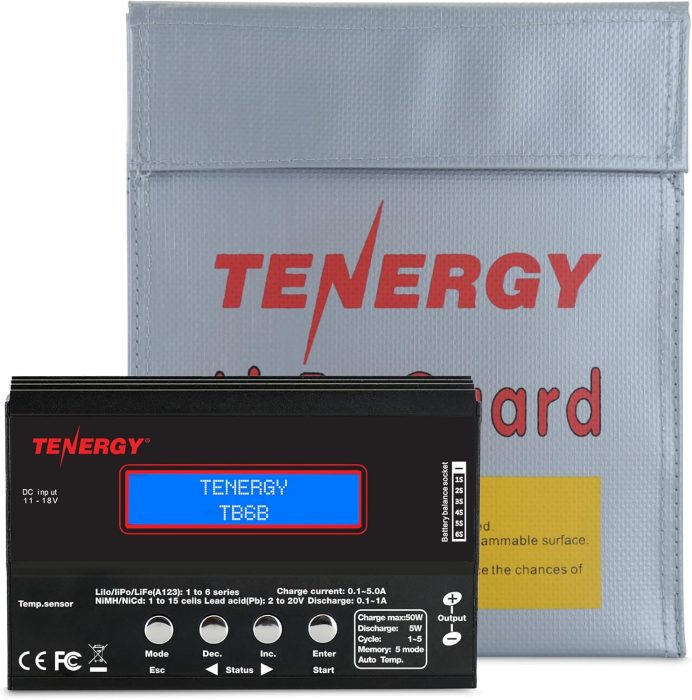
1. Tenergy TB6-B Balance Charger
The TB6-B has been around for ages and honestly, it’s kind of earned its place as the “safe boring choice” for beginners — and I mean that as a compliment. It charges and balances NiMH, NiCd, LiPo, Li-ion, LiFePO4, and SLA batteries. Coming with an octopus multi-charging harness that includes Tamiya, JST, EC3, HiTec, Deans, and XT60 connectors, you’re unlikely to need adapters for anything in your collection. It comes bundled with a power supply too, so you don’t need to source that separately. The LCD screen is readable, the menus are a bit old-school but usable, and it maxes out at 50W which is fine for 2S-4S packs if you’re not in a rush. Not the fastest thing in the world — charging a big 4S at 50W takes a while — and the interface will feel dated next to newer chargers. But it works reliably and Tenergy is a real brand with real support. Good starting point.
Good for: Beginners, first charger, mixed battery types, comes with power supply
Downside: 50W ceiling is limiting for bigger packs, old UI

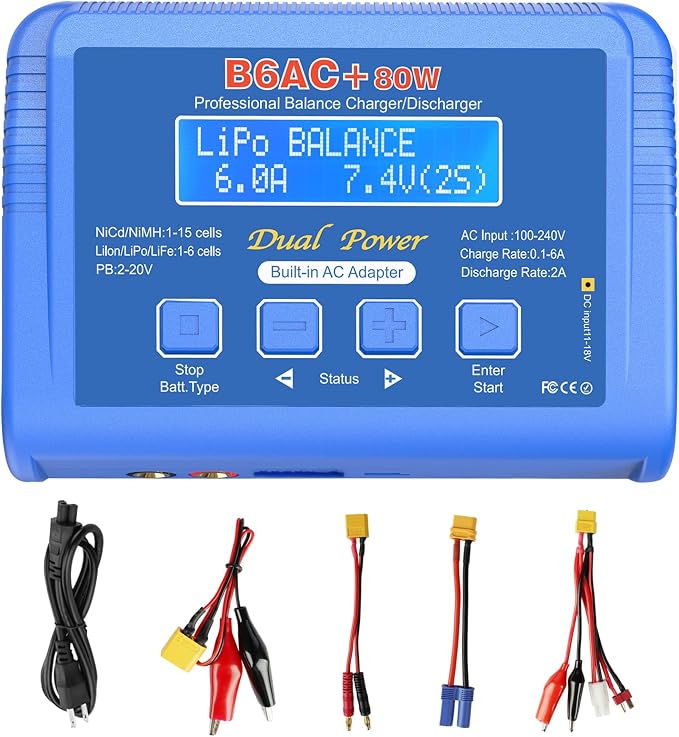
2. Generic 80W 6A Smart Balance Charger (B6 Style)
You’ve almost certainly seen these. The B6-style charger has been cloned a hundred times over and the generic 80W 6A variants floating around Amazon are honestly fine for budget buyers. They support 1S-6S LiPo, LiFe, Li-ion, and NiMH, come with an LCD screen, and handle charge, discharge, balance, and storage modes. At 80W they’re a step up from the TB6-B for charging speed. The catch — and this is a real one — is that quality control can be hit or miss. Some units are great, others have safety features that don’t work properly. If you go this route, buy one with solid reviews and a reasonable return policy. I wouldn’t leave it unattended charging a big pack. But for small 2S and 3S packs for park flyers and trainers? Works fine and costs practically nothing.
Good for: Budget buyers, small packs, occasional flyers
Downside: QC variability, don’t leave it unattended
Mid-Range Smart Chargers ($50–$120)
This is where things get interesting. For most RC airplane pilots, a charger in this range does everything you need — smart features, solid power, proper safety, and still fits in the bench space without eating your hobby budget.
3. SkyRC B6Neo Smart Balance Charger
This one is probably my pick for most people right now, and I don’t say that lightly. The B6Neo is absurdly compact — seriously, it’s smaller than a credit card — but packs 200W when powered from DC and up to 80W via USB-C PD input. That USB-C charging compatibility is genuinely useful for field use if you have a PD power bank or laptop-style power supply. It supports 1S-6S LiPo, LiHV, Li-ion, LiFe, NiMH, and NiCd. The ColorX interface is clean and easy to navigate. It also functions as a battery checker when connected to the balance port, which comes in handy when you’re at the field wondering if a pack is ready to fly. Storage mode is included, active balancing is included, firmware updates via the Charger Master app are straightforward. The fan runs quiet even under load. Honestly, the main gripes are minor — the discharge power (24W) is modest, and the claimed 80W from USB-C sometimes runs a bit lower in practice depending on your PD source. Neither of those things matter for most hobbyists. It’s a lot of charger for the money.
Good for: Home use and field use, 1S-6S packs, beginners and intermediate pilots
Downside: Needs a separate DC power supply for full 200W, discharge is slow

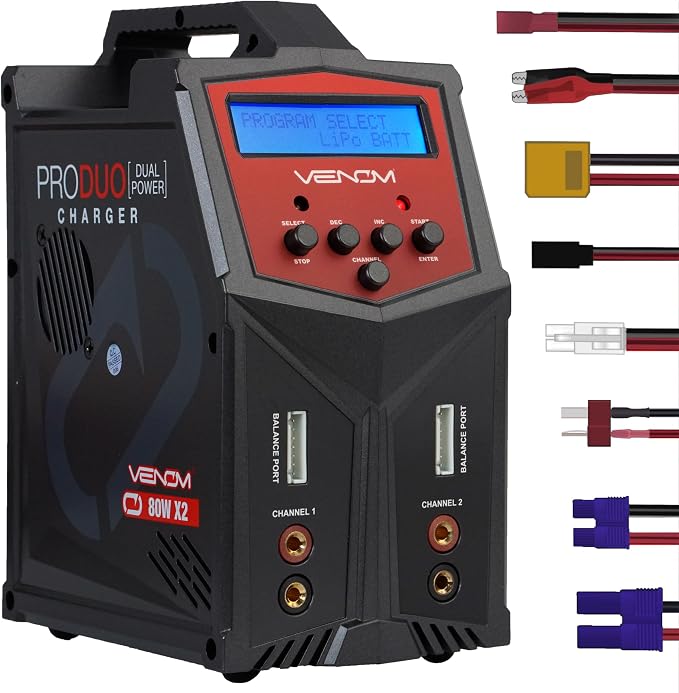
4. Venom Power Pro Duo LiPo Battery Charger
The Venom Pro Duo is a dual-port AC/DC charger that lets you charge two batteries at the same time through independent 80W circuits — total 160W. It’s got a decent LCD screen, supports 1S-6S LiPo, LiHV, Li-ion, LiFe, NiMH, NiCd, and Pb. The package includes 8 different charging leads: Deans, EC3, EC5, JST, RX, Tamiya, XT60, and a balance lead, so you probably won’t need adapters. It handles balance charging, fast charging, discharging, cycling, storage charging, and battery profiling. The integrated handle is a nice touch for portability. It’s heavier than the pocket chargers but it’s self-contained and just works. The fan can get a bit noisy over time — that seems to be a known thing with this model based on user reports. Not a dealbreaker, but worth knowing. For someone who wants an all-in-one dual charger that works out of the box without sourcing a power supply, this is a decent pick.
Good for: Dual simultaneous charging, all-in-one AC/DC, connector variety
Downside: Fan noise reported after extended use, 80W per channel is modest
Brand-Ecosystem Chargers (Spektrum / E-flite Users)
If you fly E-flite or Horizon Hobby aircraft and are already invested in Spektrum Smart batteries, you might as well lean into the Smart ecosystem. These chargers are designed to work seamlessly with Smart packs — though they also charge regular LiPos fine.
5. Spektrum S2100 G2 Smart Charger (2x100W AC)
The S2100 G2 is Spektrum’s dual-output AC charger, and if you own Spektrum Smart batteries it genuinely makes charging simpler. Connect a Smart battery and it auto-detects the chemistry, capacity, and your preferred charge rate — just hit Start. That’s it. No menu diving, no cell count confirmation, no fussing. The charger stores charge cycle data, health history, and other battery info through the IC3/IC5 connectors. For pilots with kids or people who just don’t want to think about charger settings, that’s actually pretty valuable. It does 100W per channel or 200W on one channel if needed. The 2.4″ display is clear and the button layout is straightforward. Non-Smart batteries work fine through regular JST-XH balance leads, but you don’t get the Smart features. The fan can be a bit loud, and the Smart ecosystem is essentially locked to Horizon Hobby products — if you mix brands, the Smart stuff doesn’t kick in. But if you’re all-in on Spektrum, this is the natural charger to buy.
Good for: Spektrum Smart battery users, plug-and-charge simplicity, E-flite aircraft owners
Downside: Smart features only with Spektrum batteries, fan noise, pricier for what you get

Dual-Channel High-Power Chargers (Advanced Pilots)
If you fly multiple aircraft, run a bigger setup, or just want to charge two packs simultaneously without waiting around, these are your options. A bit more money, a lot more capability.
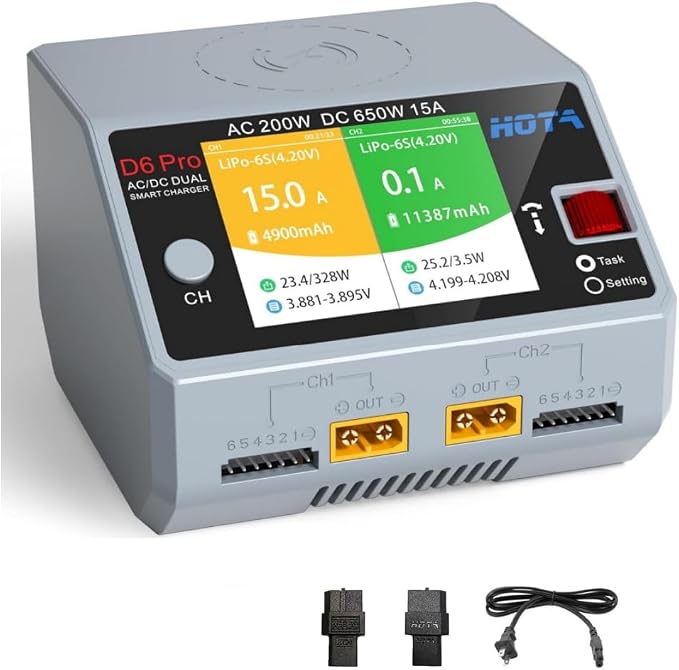
6. HOTA D6 Pro Dual Channel Smart Charger
The HOTA D6 Pro is a proper workhorse. Dual channel, up to 325W per channel on DC (650W total), or 200W on AC — split across both ports. Charge current goes up to 15A per channel. Supports LiHV, LiPo, LiFe, Li-ion, NiMH, NiCd, Lead Acid, even Eneloop cells. The built-in smart chip auto-identifies battery parameters so you don’t have to manually set cell count every time — just connect and go. It’s got a wireless charging pad on top for your phone (yes really) and a 5V USB output too. The color LCD is nice and the knob-based interface works well. At 584g it’s not heavy for what it does. Auto-shutdown when full, overtemperature protection, short circuit protection — all present. The only thing I’d flag is that AC power (200W) shared between two channels means you’re not getting 200W per side on AC — you’re splitting it. For full power you really want a DC source. But for most people at the bench on AC, charging two packs at 100W each is totally fine and faster than most single chargers anyway.
Good for: Multiple aircraft, dual simultaneous charging, AC/DC field use
Downside: AC power splits between channels, best results need DC power supply
7. Gens Ace IMARS D300 Dual Channel Smart Charger
Gens Ace is a well-known battery brand, and their IMARS D300 charger is genuinely solid. It’s 300W AC / 700W DC across dual channels with up to 16A per side. Supports 1S-6S LiPo, LiHV, LiFe, Li-ion, and NiMH. Like the HOTA, it auto-identifies G-Tech smart battery parameters if you use Gens Ace packs, but works fine with any brand. The 2.4″ IPS screen is clear and bright, the menus have 7 operating modes including storage, ExtDischarge, and SyncCharging. The UL94-V0 flame retardant housing is a nice touch — means the charger itself is more resistant if things go sideways. It comes with EC3, EC5, and T-plug adapter cables plus dual XT60 ports. This is a serious charger for a serious multi-aircraft hobby setup. The price is a bit higher but the build quality and feature set justify it if you’re running several models. The one thing to note: AC and DC inputs shouldn’t be used simultaneously — pick one.
Good for: High-output charging, Gens Ace battery users, serious multi-aircraft pilots
Downside: Don’t use AC and DC simultaneously, price is above budget options

Portable Field Chargers (USB-C / DC Powered)
Flying at the field means power outlets aren’t guaranteed. These chargers run off DC sources — car batteries, field power supplies, or USB-C PD power banks — making them genuinely portable for away-from-home flying sessions.
8. SkyRC B6AC Neo Balance Charger (AC/DC)
The B6AC Neo is the version of the B6Neo family with a built-in AC input, meaning you can plug it directly into a wall outlet at 60W or use a DC source for the full 200W. That makes it a bit more self-contained than the base B6Neo. It does everything the B6Neo does — balance charge, discharge, storage mode, battery checker, digital power supply function — in a very compact body. If you’re usually at the bench and want something truly all-in-one, the AC Neo version makes sense. The tradeoff is that the AC power is capped at 60W, which is enough for most 2S-4S packs but slower on bigger cells. For 6S packs, you’ll want a DC source anyway to get the full 200W. Good charger overall — just be clear about which version you’re buying since there are a few variants in the B6Neo family.
Good for: Home and field use, all-in-one AC/DC, compact setup
Downside: AC limited to 60W, need DC for full power
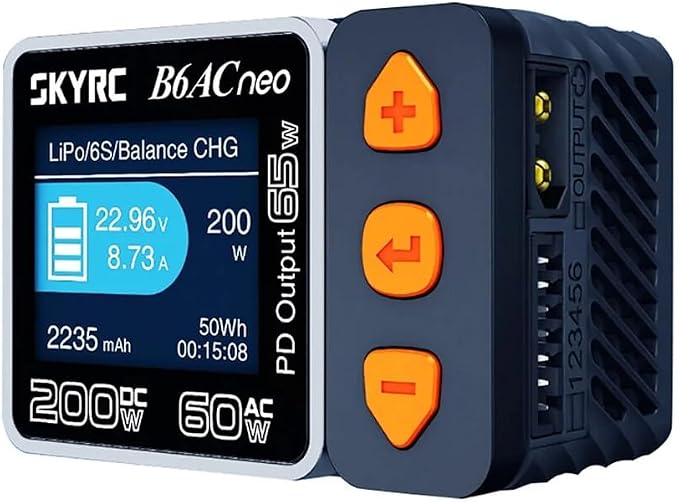
9. ISDT 608PD Lipo Battery Charger
The ISDT 608PD is a newer model that supports both USB-C PD input (up to 100W at 5A) and DC input (240W at 10A). For a field charger that you want to run off a quality USB-C PD power bank or wall adapter, this is currently one of the better options. It handles 1S-6S LiPo, LiHV, LiFe, Li-ion, 1-16S NiMH, and 1-12S Pb. The LCD display is clear. Firmware is updatable via the USB-C port. It’s a compact single-channel charger that packs solid capability for its size, and the dual input modes (PD + DC) give you real flexibility at the field. The 10A max charge current covers most airplane battery setups comfortably. Not as flashy as some of the big dual-channel units but if you’re looking for a compact high-capability single charger for field use, this is worth a look.
Good for: USB-C PD powered field charging, compact and capable, 1S-6S
Downside: Single channel only, no AC input

Charging Safety Accessories
Before I wrap up with the comparison table, a word on LiPo safety gear. Even with good chargers, LiPo fires do happen — usually from damaged packs, overcharging, or leaving things unattended. A couple of cheap accessories can make a big difference.
10. Tenergy LiPo Safe Charging Bags (2-Pack)
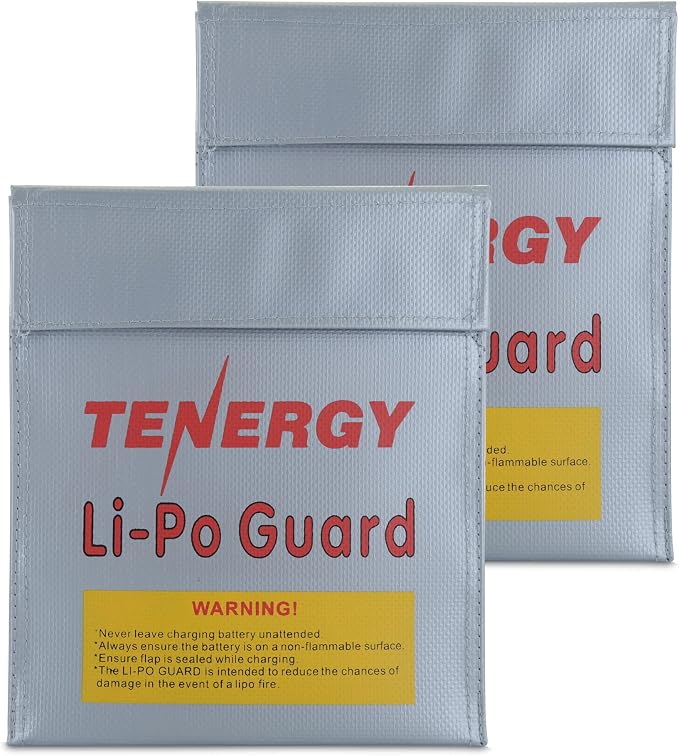
The Tenergy fireproof bag uses triple-layered flame retardant material that meets UL 94 flammability standards. The idea is simple — if a pack vents or catches fire during charging, the bag contains it. It closes with a velcro seal that reduces airflow while the pack is enclosed. The bags measure 7 x 9 inches, fit packs up to about 6 inches long, and come as a 2-pack. It’s not expensive and it’s the kind of thing you only appreciate if something goes wrong. Honestly, anyone charging LiPos at home on a workbench should have one of these — or at least charge on a concrete or ceramic surface away from flammable stuff. The bag gives you an extra layer of peace of mind. The TB6-B bundle mentioned above includes a LiPo bag, but you can also grab these standalone.
Good for: LiPo charging safety, storage, peace of mind
Downside: Not a substitute for supervision — always keep an eye on charging packs
Quick Comparison Table
| Charger | Max Power | Channels | Input | Cell Support | Best For |
|---|---|---|---|---|---|
| Tenergy TB6-B | 50W | 1 | AC/DC | 1-6S | Beginners |
| SkyRC B6Neo | 200W (DC) | 1 | DC / USB-C PD | 1-6S | Most hobbyists |
| Venom Pro Duo | 160W (80W×2) | 2 | AC/DC | 1-6S | Dual charging, all-in-one |
| Spektrum S2100 G2 | 200W (100W×2) | 2 | AC | 1-6S | Spektrum Smart users |
| HOTA D6 Pro | 650W (DC) | 2 | AC/DC | 1-6S | Advanced / multi-aircraft |
| Gens Ace IMARS D300 | 700W (DC) | 2 | AC/DC | 1-6S | High-power dual charging |
| SkyRC B6AC Neo | 200W (DC) / 60W (AC) | 1 | AC/DC | 1-6S | All-in-one home + field |
| ISDT 608PD | 240W (DC) / 100W (PD) | 1 | DC / USB-C PD | 1-6S | USB-C field charging |
Frequently Asked Questions
Do I really need to balance charge my LiPo batteries?
Yes, absolutely. Skipping balance charging on multi-cell packs leads to cells drifting out of alignment — one cell ends up overcharged while another is undercharged. Over time this causes swelling, reduced capacity, and in the worst cases, thermal runaway. Always use balance charge mode for any pack with more than one cell. It takes slightly longer but your batteries will last much longer and behave more predictably.
What’s the right charge rate for RC airplane LiPo batteries?
The standard safe rate is 1C — meaning a 2200mAh pack charges at 2.2A, a 5000mAh pack at 5A, and so on. Many modern LiPo packs are rated for 2C charging which halves charge time, but always check the battery’s spec sheet first. Charging faster than the pack is rated shortens its life and increases risk. For most RC airplane flying — where you’re not swapping packs every 5 minutes — 1C is absolutely fine.
Can I use a car battery to charge at the field?
Yes — most DC chargers work fine with a 12V car battery or a dedicated field power supply. Just make sure the charger supports your car battery’s voltage range (typically 11-14.8V depending on charge state). This is actually a very common setup at RC flying fields. You can also use dedicated power supplies or quality lithium “jump starter” packs as DC sources. Don’t use a running car’s alternator output directly without checking your charger specs first.
What’s storage mode and should I use it?
Storage mode charges or discharges your LiPo pack to approximately 3.8V per cell, which is the ideal long-term storage voltage. Storing packs at full charge (4.2V/cell) or fully discharged stresses the cells and reduces capacity over time. If you’re not flying for a week or more, storage mode is genuinely worth using. It’s one of those features that pays off over a year or two in noticeably better battery health.
Do I need a separate power supply for DC chargers?
Yes, DC-only chargers like the base SkyRC B6Neo need an external DC power source. At the bench, you’d typically pair them with a dedicated switching power supply (usually 12-24V, 15-30A). At the field, a car battery or DC power station works. Some chargers like the B6AC Neo or the HOTA D6 Pro have AC input built in, so they plug straight into the wall — no separate supply needed for home use. If convenience at home matters, check whether the charger includes AC input before buying.
Final Thoughts
Look, a charger isn’t the most exciting purchase in this hobby. But it might be the most important one after safety gear. Get this right and your batteries last longer, your flying sessions are more consistent, and you’re not nervously watching a pack bubble up on the bench.
For most RC airplane pilots flying 2S-4S packs with a few aircraft, the SkyRC B6Neo is hard to beat for the money — compact, smart, USB-C capable, and properly featured. Pair it with a $30 power supply and you’re set. If you need dual charging or you’re all-in on Spektrum gear, the Spektrum S2100 G2 or the HOTA D6 Pro step up to do the job.
And whatever you use — charge in a fireproof bag, don’t leave it unattended, and put your packs in storage mode when they’re sitting idle for a while. Future-you will thank present-you.
If you haven’t sorted out what batteries to pair with your setup, check out the best LiPo batteries for RC airplanes guide. And if you’re building and need help with the full power system, the brushless motor guide, ESC guide, and propeller guide cover the rest of the chain.