
Best RC Airplanes for Beginners: The Complete Buying Guide
So you’ve decided you want to fly RC airplanes. Good. Welcome to the hobby that will slowly consume your weekends, your garage shelf space, and whatever sanity you had left after the kids moved out. I’m kidding. Mostly.
The good news is that getting into RC flying has genuinely never been easier. The planes available today — even at budget prices — come with stabilization systems that would’ve seemed like science fiction 15 years ago. I remember learning on a high-wing trainer that wanted to swap ends every time the wind picked up. The new stuff is nothing like that. You can hand-launch some of these, press a button, and the thing basically flies itself while you figure out which stick does what.
The bad news, as always, is the sheer amount of options. Budget or premium? RTF (Ready-to-Fly) or BNF (Bind-N-Fly)? Trainer or something that looks a little cooler? High-wing, low-wing, glider? It gets confusing fast, especially when you’re brand new and don’t yet have strong opinions about any of it.
This guide cuts through that noise. I’ll walk you through what to actually look for, then give you specific product picks organized by type and situation — all stuff that’s actually available on Amazon right now, with real reviews behind them. Let’s get you airborne.
Some links in this article are affiliate links. If you click through and buy something, I may earn a small commission at no extra cost to you. As an Amazon Associate, I earn from qualifying purchases. Thanks for supporting the site!
Quick Picks at a Glance
| Category | Pick | Why |
|---|---|---|
| Best Budget Pick | VOLANTEXRC 3-Channel EPP Park Flyer RTF | Cheap, stable, 6-axis gyro, everything included |
| Best Premium Trainer | E-flite Apprentice STS 1.5m RTF | Big, stable, GPS-ready, the definitive club trainer |
| Best True RTF (Nothing Extra) | HobbyZone Duet S 2 RTF | Everything in box, just charge and fly |
| Best Beginner Warbird | VOLANTEXRC P51D Mustang 4CH RTF | Warbird looks, trainer-level gyro stability |
What to Look for in a Beginner RC Airplane
Before diving into the picks, here’s a quick rundown of what actually matters when you’re buying your first plane. Two minutes here saves you from buying the wrong thing.
High-Wing vs Low-Wing
High-wing planes — like most trainers — are naturally more stable. Gravity keeps them upright because the weight is below the wing. Low-wing planes look cooler but are less forgiving. For beginners: high-wing, full stop. Warbirds can wait.
Completion Level: RTF, BNF, PNP
RTF (Ready-to-Fly) includes the plane and transmitter — and sometimes a battery and charger. BNF (Bind-N-Fly) includes the plane with electronics but no transmitter. PNP (Plug-N-Play) is just the plane — you supply everything else. If you’re a total newcomer, go RTF. It’s just simpler.
Flight Stabilization Systems
Horizon Hobby’s SAFE technology and VOLANTEXRC’s Xpilot system are the big two in this price range. Both help prevent over-control and crashes by electronically limiting how far the plane can bank or pitch in beginner mode. They’re training wheels for the air. Use them, then work your way to full manual control over time.
Foam Construction
EPO foam (expanded polyolefin) is the standard for modern trainer aircraft — light, reasonably tough, repairable. EPP (expanded polypropylene) is even more flexible and crash-resistant. Some Volantex planes use durable plastic fuselages. What you don’t want: cheap brittle plastic that shatters on impact.
Wingspan and Size
Bigger planes are generally easier to see and more stable in light wind but require more space and are harder to transport. For most beginners, 900mm–1300mm wingspan is the sweet spot for outdoor flying. Micro planes are fine for parks but get pushed around by wind.
Budget Reality
You can spend $50 to $500+ on a beginner RC airplane. The cheap end gets you something that flies and teaches the basics but with weaker stabilization and cheaper parts. The upper end gives you a proper trainer that RC clubs use for instruction. Don’t go super cheap if you’re serious — you’ll upgrade in three months anyway. But don’t go overboard on your very first plane either.
Category 1: Classic Trainers — The Safe, Proven Path
These are the planes with the longest track records. Designed specifically for learning, solid support ecosystems, used at RC clubs everywhere. If you want the tried-and-tested path to actually becoming a competent pilot, this is it.
1. HobbyZone Carbon Cub S 2 1.3m RTF Basic — Best Scale Trainer
The Carbon Cub S 2 is the plane that RC clubs actually use to teach new pilots. Based on the real-world Carbon Cub bush plane from CubCrafters, it’s a taildragger — which means slightly trickier ground handling than a tricycle-gear trainer — but a more authentic, satisfying flying experience. The oversized “tundra” tires help a lot on grass and dirt, and there’s even a float option if you’ve got a suitable pond nearby.
It has the full SAFE suite and supports an optional GPS module that can be added later for AutoLand functionality — the plane can land itself at the touch of a button. That’s genuinely impressive technology for a trainer. Flight times are solid, and the 30A telemetry-capable ESC gives real-time power data to compatible transmitters.
One caveat: RTF Basic means you still need to buy the battery and charger separately. This is a recurring Horizon Hobby frustration and it’s worth mentioning. The plane itself, though, is excellent — one of those purchases you just don’t regret.
Pros: Scale looks, SAFE tech, optional GPS/AutoLand upgrade path, great community support, versatile across multiple surfaces and conditions.
Cons: Taildragger requires more ground handling finesse, battery not included in RTF Basic.
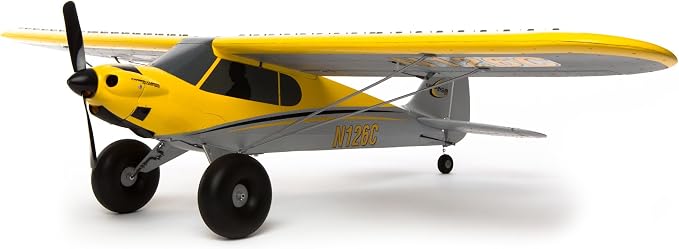
2. E-flite Apprentice STS 1.5m RTF Basic — Best Premium Trainer
The Apprentice STS is what you buy when you’re serious about this. It’s the big one — 1.5m wingspan — and that size matters. Bigger planes are easier to see at distance, more stable in wind, and generally more forgiving for new pilots. This thing is used at real RC flying clubs as an instruction aircraft, which tells you everything about how capable and predictable it is.
Smart technology compatibility means it works with Spektrum’s ecosystem of Smart batteries and chargers. The optional GPS module for SAFE Plus adds AutoLand and Virtual Fence features. The Landing Assist Sensor (LAS) automatically flares the plane for smoother touchdowns. There’s a lot of technology here, and it actually matters when you’re learning.
The price is higher than other trainers, and — you guessed it — battery not included in the RTF Basic version. But if you’re planning to stay in this hobby long-term, the Apprentice STS is not a waste of money. You won’t outgrow it quickly, and it’s the kind of plane you can use to teach someone else later on.
Pros: Big size means great stability and visibility at distance, proper club-level trainer, GPS/AutoLand upgradeable, great parts availability.
Cons: Expensive compared to budget options, still needs separate battery and charger, requires more space to fly safely.

Category 2: Budget-Friendly — VOLANTEXRC Options
VOLANTEXRC has basically cornered the affordable end of the RTF RC airplane market, and they do a decent job for the price. The Xpilot stabilization system is comparable to SAFE in its beginner-level functionality. The planes are light, fly predictably, and don’t cost a fortune to replace if you have a bad day.
The trade-offs are real: build quality isn’t as refined as HobbyZone or E-flite, parts availability isn’t as robust, and the included transmitters are basic. But for a first plane where you expect to learn the hard way a few times? Volantex makes a lot of sense.
3. VOLANTEXRC 3-Channel EPP Park Flyer RTF — Best Budget Trainer
This little 3-channel Volantex is about as entry-level as it gets for something genuinely functional. It’s a 400mm park flyer with WWII fighter styling, twin built-in motors and a 6-axis gyro stabilizer that does most of the work of keeping it level. It’s the kind of plane you can throw in a bag and take to the park without worrying much about it. It comes RTF with everything included — transmitter and two rechargeable batteries — which is more than some of the HobbyZone planes can say.
It’s not going to challenge you after a month, but it will teach you the basics of throttle management, turns, and maintaining orientation. The EPP foam shrugs off the light crashes you’ll have early on, and you can either hand-launch it or take off from the ground. With two batteries in the box, Volantex quotes up to 40 minutes of total flying.
Be aware: it’s small, which means it gets pushed around in any real wind. Calm days only.
Pros: Genuinely RTF with everything included, affordable, gyro-stabilized, tough EPP foam, two batteries in the box.
Cons: Very small — not for windy days, only 3-channel, you’ll want something bigger after a couple of months.
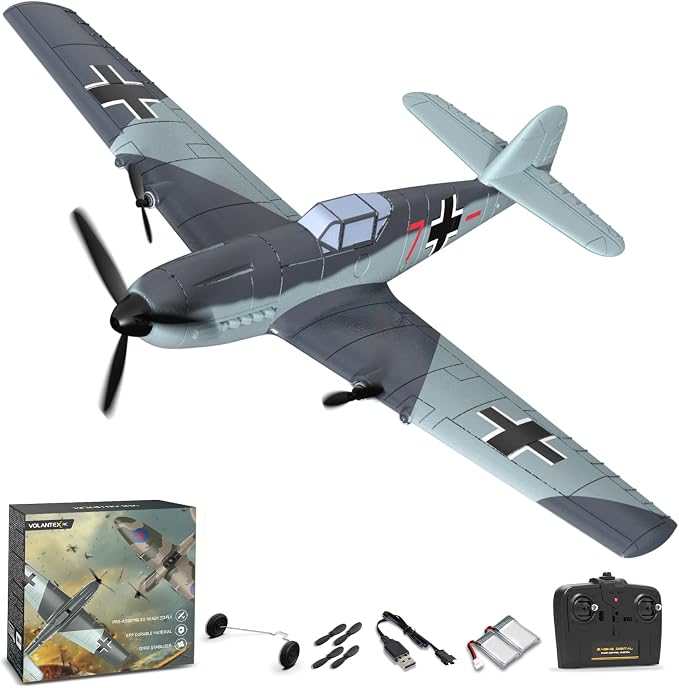
4. VOLANTEXRC TrainStar 500mm Brushless RTF — Budget Step-Up
Step up to the 500mm brushless TrainStar and you get noticeably more for not a huge price difference. Brushless motor means more efficient power, better performance, and longer motor life. The Xpilot gyro handles stabilization across three modes. One-key aerobatics let you do rolls and return-to-home at a button press, and flight time of around 20 minutes on a battery is genuinely decent for this price bracket.
This is a solid step-up plane — the kind of thing you could start on and realistically fly for a full season before needing anything bigger. The 4-channel control gives you proper aileron input, which starts to teach real stick coordination. Build quality is typical Volantex: fine, not amazing, but it handles light crashes without drama.
Pros: Brushless motor, 4-channel control, good flight times, spring-loaded landing gear, one-key aerobatics for fun factor.
Cons: Still light enough to struggle in meaningful wind, basic transmitter included, foam isn’t quite as tough as EPO on the Horizon Hobby planes.
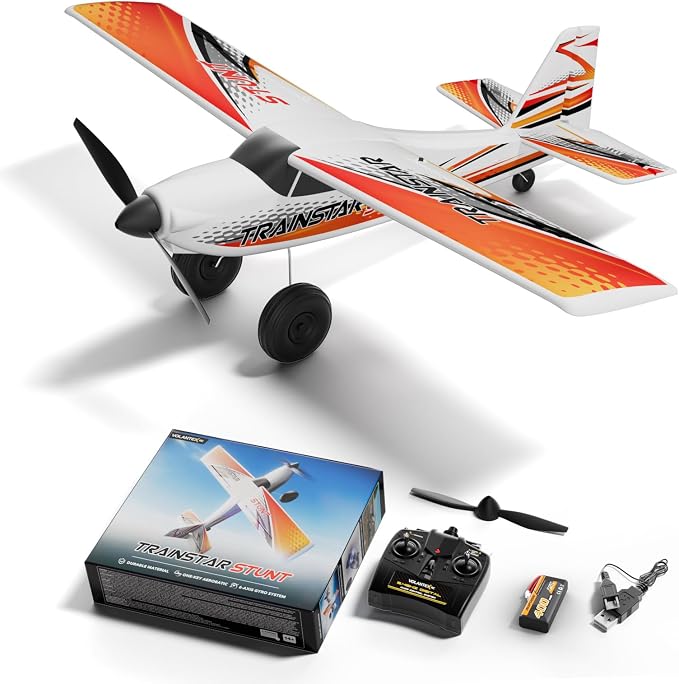
Category 3: True All-In-One — Nothing Extra Required
One of the most common frustrations I hear from new buyers is spending money on a plane, then finding out they still need a battery, a charger, or both. The planes in this section are genuinely complete out of the box. Charge the included battery, put batteries in the transmitter, and fly. No extra shopping trip required.
5. HobbyZone Duet S 2 RTF — Most Complete Package
The Duet S 2 is one of the cheapest ways to get into Horizon Hobby’s SAFE technology with absolutely nothing else to buy. The box contains the plane, the transmitter, the LiPo battery, the USB charger, and AA batteries for the transmitter. Open box, charge for a bit, fly. Under 250 grams so no FAA registration required in the US — one less thing to deal with if you just want to get flying.
It’s ultra-micro — the 525mm wingspan means it flies in parks and backyards where a bigger trainer would be too large. Twin motors, 3-channel control, SAFE in beginner and experienced modes. The twin-motor layout makes it pretty stable and easy to keep level. Flight time is short at around 10 minutes per charge (the included 150mAh 1S pack is tiny), but you can buy extras for cheap.
This is a great “first flight ever” plane or a solid gift for someone who doesn’t want any complexity whatsoever. It’s not going to challenge you for long, but it’s the cleanest possible entry into the hobby.
Pros: Completely RTF with nothing else needed, SAFE technology, sub-250g (no FAA registration), twin motors for stability, cheap to operate.
Cons: Short flight times, 3-channel only, you’ll want something larger after the novelty wears off, strictly park and backyard sized.
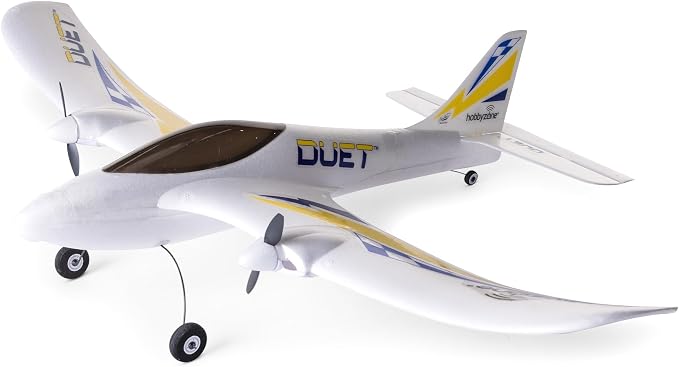
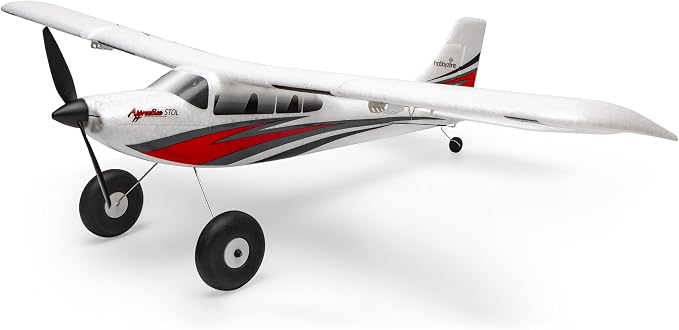
6. HobbyZone Apprentice STOL S 700 RTF — Traditional Trainer, Complete
The Apprentice STOL S 700 sits between the tiny Duet S and the full-size Apprentice STS. It’s scaled down from the popular Apprentice 1.5m and 1.2m trainers to an ultra-micro 700mm size, and tuned for short takeoffs and landings (STOL), so it gets off the ground and back down in very little space. The RTF version is 100% complete — nothing extra to buy.
SAFE technology helps prevent crashes while you learn, backed by AS3X stabilization. The box includes a 6-channel Spektrum transmitter with SLT 2.4GHz and a trial of the RealFlight Trainer Edition simulator, so you can practice on screen before the first real flight. It keeps the classic high-wing trainer proportions, and Horizon Hobby parts support means you can get replacement pieces without too much drama.
Being an ultra-micro, it’s happiest in calm conditions — a breezy day will push it around more than the bigger trainers above. But as a complete first plane for parks and sports fields, it’s hard to argue with.
Pros: Complete RTF (nothing extra needed), traditional trainer layout, SAFE + AS3X, STOL for small fields, simulator trial included.
Cons: Ultra-micro size is sensitive to wind, and you’ll want spare batteries for longer sessions.
Category 4: Beginner-Friendly Warbirds — For When You Want to Look Cool
Not everyone wants to learn on something that looks like a flying doorstop. Some of us would rather have a plane that actually resembles something historical and interesting. The planes in this section look like proper WWII aircraft while still having enough assistance built in to be manageable for newer pilots.
Honest tradeoff: warbird shapes are less inherently stable than high-wing trainers. They feel a bit more lively in the air and don’t forgive sloppy inputs quite as much. But modern gyro stabilization bridges that gap considerably, especially on these Volantex designs.
7. VOLANTEXRC P51D Mustang 4CH RTF — Best Beginner Warbird
The VOLANTEXRC P51D has been around long enough to accumulate a mountain of reviews and a solid reputation as the best beginner warbird at its price point. It looks the part — WWII Mustang livery, realistic proportions — and it flies well enough for a new pilot thanks to the Xpilot gyro across three stabilization modes. 4-channel control means proper aileron input, not just rudder steering.
Flight time is around 20 minutes on the included battery, which is excellent. The EPP foam body handles light crashes well. One-key aerobatics for rolls and auto-return add fun once you’ve got the basics down. It’s not going to feel as planted as a dedicated high-wing trainer, but it’s not nearly the handful you’d expect from a proper low-wing warbird either.
The honest note: don’t start on this if you’ve literally never flown RC anything. Do a few sessions on a trainer first, or at minimum some simulator time. As a second plane, or a first plane for someone with sim hours behind them, the P51D is genuinely entertaining.
Pros: Looks great, gyro-stabilized, 4-channel, solid flight times, everything included RTF, solid reviews.
Cons: Low-wing warbird is less stable than a dedicated trainer, not ideal as an absolute first plane, basic stock transmitter.

Category 5: Gliders for Beginners — Slow, Forgiving, and Underrated
Gliders deserve more attention in the beginner conversation. They’re slower, which makes them much easier to control — there’s more time to think between input and consequence. Long wingspans give excellent inherent stability. And they’re usually quieter, which matters if you’re flying somewhere with noise sensitivities.
The downside: gliders are physically bigger and more awkward to transport, and some versions require you to supply your own radio and battery. They’re also less exciting-looking to a lot of new pilots who want speed. But for sheer ease of learning actual flight control, a good glider is hard to beat.
8. VOLANTEXRC Ranger600 Stunt 4CH RTF — Compact Glider Trainer
The Ranger600 Stunt is a smaller, more compact take on the glider trainer concept. At 600mm wingspan, it fits in your car without disassembly drama and can be flown at most parks. Pusher-prop design protects the prop from ground strikes — smart on a plane aimed at beginners. Xpilot gyro, 4-channel control, 3 flight modes, and you can hand-launch it, which avoids the whole landing gear conversation entirely for the first few flights.
Flight times are claimed at around 20-30 minutes in mixed throttle use, which is impressive for a compact plane. One-button aerobatics means you can have some fun once orientation is sorted. Punches above its weight class for the price.
It’s not a sophisticated long-range glider like the bigger Volantex models, but as a compact beginner plane with glider stability, it’s a legitimate option that a lot of new pilots seem to enjoy without too much drama.
Pros: Compact and easy to transport, hand-launch capable, good flight times, tough pusher-prop config, fun aerobatics for when you’re ready.
Cons: Small size means meaningful wind is still a concern, not as visually impressive as the bigger Ranger series, limited natural upgrade path.

Full Comparison Table
| Plane | Wingspan | Channels | Stabilization | Completion | Battery Incl. | Best For |
|---|---|---|---|---|---|---|
| HobbyZone Carbon Cub S 2 1.3m | 1300mm | 5 | SAFE + GPS option | RTF Basic | No | Scale trainer, upgrade path |
| E-flite Apprentice STS 1.5m | 1500mm | 4 | SAFE + Smart + GPS option | RTF Basic | No | Club-level trainer, long-term |
| HobbyZone Duet S 2 | 525mm | 3 | SAFE (2 modes) | RTF Complete | Yes | True beginner, backyard/park |
| HobbyZone Apprentice STOL S 700 | 700mm | 6-ch Tx | SAFE + AS3X | RTF Complete | Yes | Full trainer, nothing to buy |
| VOLANTEXRC 3-Channel EPP Park Flyer | 400mm | 3 | 6-axis gyro | RTF Complete | Yes (x2) | Budget, park flying |
| VOLANTEXRC TrainStar 500mm | 500mm | 4 | Xpilot (3 modes) | RTF Complete | Yes | Budget brushless step-up |
| VOLANTEXRC P51D 4CH RTF | 750mm | 4 | Xpilot (3 modes) | RTF Complete | Yes | Warbird style, fun factor |
| VOLANTEXRC P51D Micro 2CH | 400mm | 2 | Gyro | RTF Complete | Yes (x2) | Absolute beginner, simple |
| VOLANTEXRC Ranger 757-4 1.4m | 1400mm | 6 | Xpilot | RTF Complete | Yes | Glider, very stable, relaxed flying |
| VOLANTEXRC Ranger600 Stunt | 600mm | 4 | Xpilot (3 modes) | RTF Complete | Yes | Compact glider, hand-launch |
Before You Buy — Things Nobody Tells Beginners
Fly a Simulator First
I cannot stress this enough. An hour on a simulator is worth three crash-repair sessions. RealFlight, Phoenix RC, or even some free options online will teach your thumbs how to react before you’ve got $200 worth of foam in the air. Several Horizon Hobby transmitters work as USB simulator controllers right out of the box. Use that feature. Check out our guide on Best RC Flight Simulator Software for the full rundown.
Buy Two Batteries Minimum
A 10-15 minute flight time sounds fine until it ends and you’re standing around watching a battery charge for 90 minutes. Buy at least two batteries. Three is better. Our Best LiPo Batteries for RC Airplanes guide has what you need to know about choosing the right ones.
You Will Crash. Plan for It.
Not maybe. You will crash your plane. Probably several times in the first few sessions. This is completely normal and it’s exactly why foam construction and parts availability matter so much. The Horizon Hobby planes have excellent spares availability. The Volantex stuff is usually repairable with foam-safe CA glue. Our Best Glue for RC Airplanes guide has everything you need for the inevitable repair sessions.
Your Transmitter Matters Long-Term
The basic transmitters included with most beginner RTF planes do the job but are essentially dead-ends — you usually can’t bind them to other brands of planes easily. If you’re planning to stick with this hobby, look at our Best RC Transmitters for Airplane Flying guide for what a proper radio upgrade looks like. A mid-range transmitter will work across your entire future fleet for years.
Consider Joining a Club
RC flying clubs are one of the genuinely underrated aspects of this hobby. A lot of them are cheap to join, they often have proper maintained flying fields, and experienced pilots are usually happy to help new people learn the basics. Some even have buddy-box training systems where an experienced pilot can take control instantly if you get into trouble. Worth looking up what’s near you before your first solo session in a field.
FAQ
What is the best RC airplane for a complete beginner?
If budget isn’t the primary concern, the HobbyZone Carbon Cub S 2 or the E-flite Apprentice STS are the most well-rounded choices — tough, capable, upgradeable, with SAFE stabilization. If you want absolutely nothing else to buy, the HobbyZone Duet S 2 or Apprentice STOL S 700 full RTF versions are your cleanest options. On a tighter budget, the VOLANTEXRC 3-channel park flyer or the TrainStar 500mm brushless gets you flying without spending a lot.
Is RTF or BNF better for beginners?
RTF is almost always the better choice for beginners. You get a transmitter that’s been matched to the plane and confirmed to work together. BNF makes sense if you already own a Spektrum DSMX transmitter from a previous plane — you can save some money. But if you’re starting from zero, RTF removes a bunch of compatibility headaches you really don’t need when you’re learning to fly.
Do I need to register my RC airplane with the FAA?
In the US, any aircraft over 250 grams flown outdoors recreationally needs to be registered with the FAA — it’s $5 and takes about 5 minutes online. Planes under 250g like the HobbyZone Duet S 2 are exempt for recreational use. Rules vary in other countries, so check your local aviation authority requirements before your first flight.
How long does it take to learn to fly RC planes?
With a proper stabilized trainer and some simulator time beforehand, most people can do basic controlled circuits — takeoff, fly around, land without breaking things — in 2-4 sessions. True proficiency: judging wind, intentional maneuvers, landing consistently well, takes more like 20-30 hours of actual flying time. It varies a lot by person and how much simulator prep they did.
What’s the difference between EPO and EPP foam?
EPO (expanded polyolefin) is the standard foam used in most Horizon Hobby planes. It’s rigid, holds its shape, and is reasonably impact-resistant. EPP (expanded polypropylene) is more flexible — bends on impact rather than cracking. Both repair fine with foam-safe CA glue. Neither is dramatically better; EPO is slightly easier to work with during repairs, while EPP is more crash-forgiving on hard impacts.
Final Thoughts
Honestly, you’re going to learn to fly regardless of which plane you pick from this list. The technology in even the cheapest stabilized trainers today is genuinely impressive compared to what was available five years ago. The goal is just picking something that won’t put you off the hobby after a couple of rough sessions.
For most people, a proven SAFE-equipped trainer like the E-flite Apprentice STS or the HobbyZone Carbon Cub S 2 remains the recommendation that holds up best — the right size, tough enough to survive learning, and actually teaches you to fly properly rather than just keeping you airborne with a ton of automation. On a strict budget, the Volantex budget options do the job without drama. And if you want something that looks cool from day one and you’ve put in some simulator hours, the VOLANTEXRC P51D 4CH is a legitimate fun first plane.
Whatever you pick — go fly. That’s the whole point. Welcome to the hobby.
Related articles you might find useful:
One Comment
Best RC Flight Simulator Software: Practice Flying Without Crashing - RC Plane DIY
[…] Best RC Airplanes for Beginners: The Complete Buying Guide — Once you’ve practiced on the sim, here’s what to actually buy and […]