

Some links in this article are affiliate links. As an Amazon Associate, rcplanediy.com earns from qualifying purchases at no extra cost to you.
So you’ve got a plane. Maybe it’s a scratch build you’ve been nursing along for three weekends, or a brand-new ARF that arrived in a box the size of a small coffin. Either way, at some point you’re going to face the battery question — and honestly, it’s more involved than most beginners expect.
I’ve spent way too much money over the years buying the wrong batteries. Packs that were too heavy, too short on capacity, or just too dumb to survive more than 40 charge cycles before turning into little foil pillows. So let me save you some of that frustration. This guide covers LiPo battery selection for RC airplanes — from the small sport trainers all the way up to larger EDF jets — broken down by cell count, capacity, and what actually matters when you’re hovering at the field trying to figure out why your plane won’t stay airborne for more than four minutes.
Before we get into products, quick picks for people who just want to skip ahead:
- Best Budget 3S (Park Flyer): OVONIC 3S 2200mAh 50C 2-Pack
- Best Mid-Range 3S: Zeee 3S 2200mAh 50C Shorty 2-Pack
- Best 4S for EDF Jets: Gens Ace 4S 2200mAh 45C
- Best High-Capacity 3S: Zeee 3S 5200mAh 50C XT60
Understanding LiPo Basics Before You Buy Anything
LiPo batteries are rated by three things you absolutely need to understand before clicking that Amazon button.
Cell count (S number): Each LiPo cell runs at 3.7V nominal (up to 4.2V fully charged). So a 3S pack is 11.1V nominal, a 4S is 14.8V. Your brushless motor and ESC are rated for specific voltage ranges — putting a 4S into a 3S system is a great way to let the magic smoke out. Match the voltage to what your plane’s power system calls for. When in doubt, check the motor specs.
Capacity (mAh): This is basically how much charge the battery holds, which translates directly to flight time. More mAh = longer flights, but also more weight. For most electric park flyers in the 1–1.4m wingspan range, 2200mAh is the sweet spot. Larger planes with bigger motors need 3300–5200mAh or more. Going too big kills your power-to-weight ratio and you end up with a flying brick that barely makes it off the ground.
C-rating: This tells you how fast the battery can discharge. Multiply C-rating by capacity (in Ah) to get max continuous current. A 2200mAh (2.2Ah) pack at 50C can theoretically deliver 110A continuously. For most sport planes, 30–50C is plenty. Higher C-ratings usually mean heavier packs, and honestly the advertised C-ratings from a lot of budget brands are… optimistic. Take them with a grain of salt.
Connector type matters too. XT60 and T-plug (Deans) are the most common. Make sure your ESC wiring matches, or you’ll need an adapter or to resolder. Some planes — especially E-flite/HobbyZone products — use EC3 or IC3 connectors from Spektrum’s ecosystem.
Section 1 — Budget 3S Packs: Best Value for Park Flyers and Trainers
These are the workhorses. If you’ve got a 1m trainer, a sport foamy, or an EDF in the 64–70mm range, a good 3S 2200mAh pack in the 35–50C range is what you need. This category is also where you’ll find the most variation in actual quality versus what’s printed on the label.
🥇 1. OVONIC 3S 2200mAh 50C LiPo — XT60, 2-Pack
OVONIC has been around since 1996 and they have an ISO quality certification that actually means something. This 3S 2200mAh 50C pack consistently gets good marks from RC airplane guys specifically — the long cycle life (rated 350 cycles) is a real differentiator, and the soft case dimensions (107×35×22mm, ~176g) fit neatly into most 1m wingspan trainers. Comes with XT60. 2-pack makes it economical to have a spare in your field bag.
The 50C rating here is more believable than some budget competitors. The one drawback is it doesn’t come in a Dean/T-connector version in the same listing, so if your ESC is T-plug you need the right variant or an adapter.
- Specs: 11.1V | 2200mAh | 50C | XT60 | Soft case | 176g
- Best for: 1m trainers, park flyers, 64mm EDF, sport foamies
- Drawback: Soft case isn’t crash-proof — hard landings can pucker the cells over time

2. CNHL 2200mAh 3S 30C LiPo — XT60, 2-Pack
A gentler 30C pack (60C burst) aimed at trainers, gliders, and light sport planes that don’t pull much current. CNHL (ChinaHobbyLine) has a solid reputation in the hobby — they’ve been making batteries since 2011 and have a decent following among FPV folks and RC pilots alike. A lower C-rating is plenty for these planes and keeps the price down. If your plane’s motor specs show peak current draw under about 40A, this is a smart buy, and the 2-pack means you can fly back-to-back.
- Specs: 11.1V | 2200mAh | 30C (60C burst) | XT60 | Soft case | 2-Pack
- Best for: Trainers, gliders, slow flyers, light sport planes
- Drawback: Not enough headroom for high-performance setups or EDF jets

Section 2 — Mid-Range 3S Packs: More Capacity and Higher C-Ratings
Once you step up from a basic trainer to a sportier plane — say something with a 1.2m wingspan doing aerobatics, or a 70mm EDF — you start wanting a bit more headroom. Either a higher C-rating for the snappier throttle response, or more mAh for longer sessions. Here’s what I’d recommend in that middle ground.
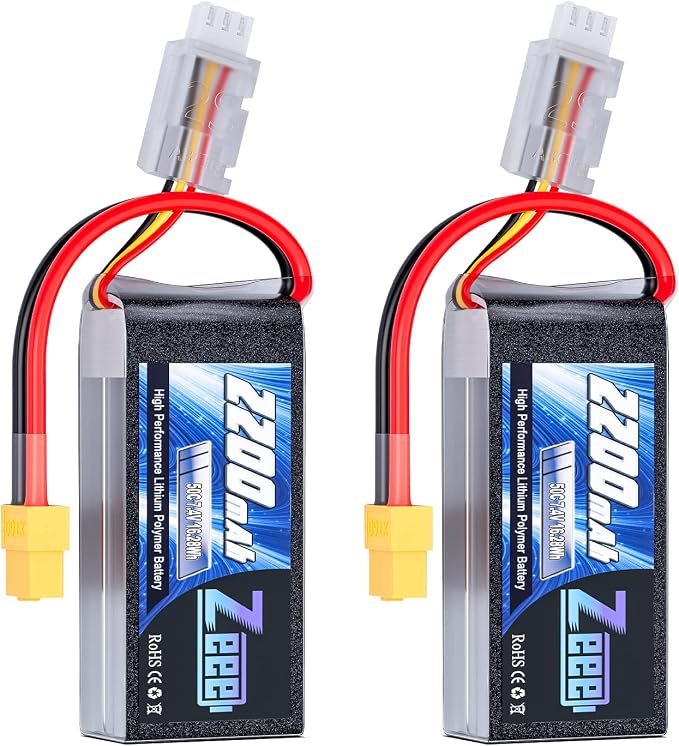
🥇 3. Zeee 3S 2200mAh 50C Shorty LiPo — XT60, 2-Pack
Zeee is one of the best-known Amazon battery brands and for good reason — they actually deliver on the specs reasonably well. This shorty pack is popular with the 1/10 RC car crowd but works really well for RC airplanes too, especially in tight battery trays. The 50C rating means it’ll handle a decent sport setup without voltage sag that makes your motor sound like it’s dying mid-roll. The 2-pack value is hard to beat at this price point.
One thing to watch: the advertised C-ratings from Zeee are probably honest-ish, but don’t expect the “burst” numbers to mean much in practice. Fly at 50–70% throttle like a normal person and these will serve you well for a long time.
- Specs: 11.1V | 2200mAh | 50C | XT60 | Shorty soft case | ~137g
- Best for: Sport trainers, aerobatic foamies, 70mm EDFs, compact battery trays
- Drawback: Shorty format — verify fitment before ordering

4. Zeee 3S 5200mAh 50C LiPo — XT60
When you want a longer flight but don’t want to mess with 4S voltages, just step up the capacity. This 5200mAh pack from Zeee is aimed at larger wingspan models — 1.4m–1.6m wingspan planes, big foamies, or any aircraft where the power system efficiency is high but you want 12–15 minutes of flight instead of 6–8. It’s heavier at around 340g, so do the CG math before you commit. If the numbers work out for your design, this pack gives you noticeably more time in the air without changing your ESC or motor.
- Specs: 11.1V | 5200mAh | 50C | XT60 | Soft case | ~340g
- Best for: 1.4m+ wingspan planes, long-duration flying, larger foamies
- Drawback: Weight penalty — check your power-to-weight ratio first. Not for small planes.

5. HOOVO 3S 2200mAh 50C LiPo — XT60, 2-Pack
HOOVO has built a decent following in the bashing and RC car community, and their airplane-compatible packs have been getting solid reviews from flyers too. The 2200mAh 50C XT60 version is priced competitively, and reviewers consistently mention good balance and no-drama charging. Nothing spectacular about these — they just work reliably, ship fast from Amazon fulfillment, and don’t puff up after 20 cycles, which puts them ahead of some of the no-name sellers clogging Amazon search results.
- Specs: 11.1V | 2200mAh | 50C | XT60 | Soft case | 2-Pack
- Best for: Sport planes, 70mm EDFs, anyone who wants a well-rounded budget pack
- Drawback: Less established brand history than Zeee or OVONIC — more hit-and-miss between batches

Section 3 — 4S LiPo Packs: For EDF Jets and High-Performance Builds
Moving to 4S (14.8V) opens up a whole different level of performance. Most 64mm–80mm EDF jets and high-performance sport planes need 4S — the extra voltage means your motor spins faster and the power system runs more efficiently. If your plane’s ESC is rated for 4S and the motor calls for it, you want to be running 4S. Don’t cheap out here — a bad 4S pack can cause a real mess at high current draw.
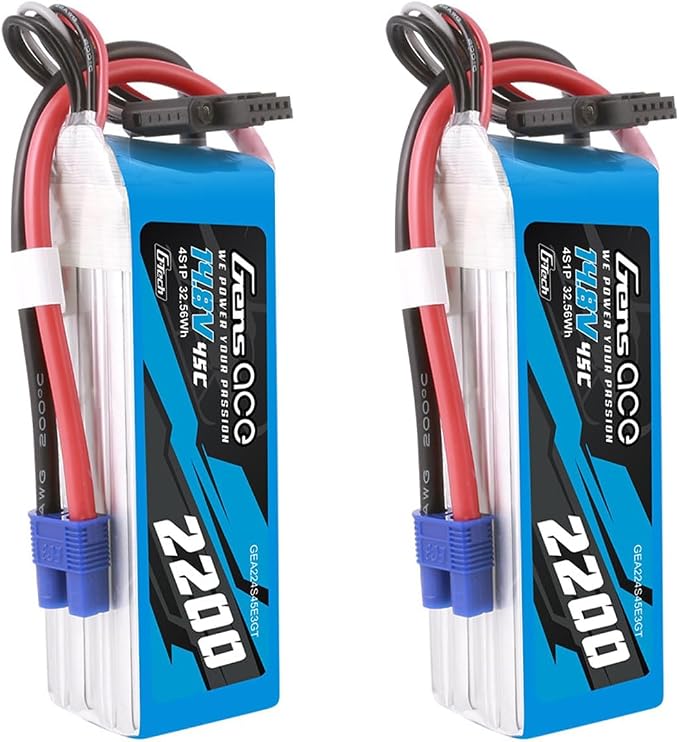
🥇 6. Gens Ace 4S 2200mAh 45C LiPo — T-Plug (Deans), 2-Pack
Gens Ace is about the most respected LiPo brand you can buy on Amazon that isn’t the size of a house payment. They’re made by Grepow, a legit Chinese battery manufacturer that supplies cells to a bunch of big names. This 4S 2200mAh hard-case pack with a T-plug comes as a 2-pack, and Gens Ace matches each cell for capacity, voltage, resistance and discharge curve — and it shows. Consistent discharge curve, no drama on the balance leads.
Weight is about 262g per pack (106×34×30mm) — check your CG on lighter jets, where every gram affects how the plane flies. The main “drawback” is price — you’ll pay more than the budget Chinese packs. But you also get what you pay for when you’re running 4S at anything approaching full throttle.
- Specs: 14.8V | 2200mAh | 45C | T-Plug | Hard case | ~262g | 2-Pack
- Best for: 70mm EDF jets, high-performance 4S sport planes, F-16 / F-15 style foamies
- Drawback: More expensive than budget brands — though the quality difference is real

7. Gens Ace 4S 2200mAh 45C LiPo — EC3 Plug, 2-Pack
Same excellent Gens Ace pack but with an EC3 connector — which you’ll need if your ESC uses EC3 or IC3 connectors (very common in Horizon Hobby / E-flite aircraft). The dimensions are 107×34×32mm, about 238g, and it comes as a 2-pack. If you’re flying an E-flite jet or any plane from that ecosystem and the wiring runs EC3, this is the plug version to get. Don’t waste time soldering adapters — just get the right connector from the start.
- Specs: 14.8V | 2200mAh | 45C | EC3 | Hard case | ~238g | 2-Pack
- Best for: E-flite, Blade, and HobbyZone aircraft with EC3 wiring
- Drawback: EC3 is specific — confirm your ESC plug before ordering
8. OVONIC 4S 2200mAh 130C LiPo — XT60, 2-Pack
If you’re on a 4S budget and can’t quite stretch to Gens Ace pricing, this OVONIC 4S 2200mAh 2-pack is worth looking at. OVONIC uses stacked-cell construction that it rates for 350+ cycles, and the packs are compact at 110 × 36 × 34mm and about 240g each. The 130C rating is… ambitious, but even if actual performance is half that, you’ve got plenty of headroom. XT60 plug, 2-pack value.
- Specs: 14.8V | 2200mAh | 130C | XT60 | Soft case | ~240g, 110 × 36 × 34mm | 2-Pack
- Best for: Budget 4S setups, 70mm EDFs, sport builds on XT60 wiring
- Drawback: C-rating is inflated — buy for the capacity and 2-pack value, not the advertised discharge number

Section 4 — High-Capacity and Specialty Packs
Bigger planes, longer flights, and specific applications sometimes need packs that don’t fit the standard 2200mAh 3S template. Here are a few options for outlier use cases.
🥇 9. Zeee 3S 3200mAh 50C LiPo — T-Connector, 2-Pack
The step between 2200mAh and 5200mAh — 3200mAh gives you roughly 35–45% more flight time over a 2200mAh pack at about 280g per pack (134 × 44 × 23mm). T-connector (Deans) version. Good for a 1.2m wingspan sport model where your CG can absorb an extra 40–50g of battery. If you’re regularly coming in after 7 minutes wishing you had a bit more air time, this is worth the swap before going all the way to a 5200mAh pack that might mess with your balance.
- Specs: 11.1V | 3200mAh | 50C | T-Connector | Soft case | ~280g, 134 × 44 × 23mm | 2-Pack
- Best for: 1.2m sport planes, intermediate pilots wanting more air time, aerobatic models
- Drawback: Slightly larger physical dimensions — measure your battery bay

10. OVONIC 3S Short LiPo 2200mAh 120C — XT60, 2-Pack (with Voltage Checker)
The shorty format with a 120C rating from OVONIC — this one’s really aimed at high-performance setups where current draw is significant. Also comes with a little LiPo voltage checker which is actually a useful bonus for field use. The 77×34×25mm dimensions are compact, which helps if you’re working around a tight motor/battery arrangement on a scratch build or short-nosed plane. The 120C claim is almost certainly an exaggeration, but even at half that you’ve got very capable discharge headroom.
- Specs: 11.1V | 2200mAh | 120C (claimed) | XT60 | Shorty soft case | ~140g | includes voltage checker
- Best for: High-performance sport planes, tight battery compartments, anyone who wants a spare voltage checker
- Drawback: 120C is marketing-speak. Good battery, but don’t design your system around that rating.

11. Zeee 2S 2200mAh 50C Shorty LiPo — XT60, 2-Pack
Don’t overlook 2S packs (7.4V). They’re perfect for micro to small park flyers, foam gliders, and any low-powered design where 3S would be overkill. A lot of small FPV fixed-wing designs and slow flyers run 2S very happily. This Zeee shorty pack is well-reviewed and light at about 98g (73×34×18.5mm), so it fits small battery bays, and the 2-pack value is good. If you’re building something in the micro category, this should be on your list.
- Specs: 7.4V | 2200mAh | 50C | XT60 | Shorty soft case | ~98g | 2-Pack
- Best for: Micro RC planes, slow flyers, foam gliders, small park flyers under 600g AUW
- Drawback: 2S limits your motor/ESC options — make sure your system is designed for 7.4V
Quick Comparison Table
| Product | Voltage | Capacity | C-Rating | Connector | Pack | Best For |
|---|---|---|---|---|---|---|
| OVONIC 3S 50C | 11.1V 3S | 2200mAh | 50C | XT60 | 2-Pack | Trainers, park flyers |
| CNHL 3S 30C | 11.1V 3S | 2200mAh | 30C | XT60 | 2-Pack | Slow flyers, gliders |
| Zeee 3S 50C Shorty | 11.1V 3S | 2200mAh | 50C | XT60 | 2-Pack | Sport foamies, 70mm EDFs |
| Zeee 3S 5200mAh | 11.1V 3S | 5200mAh | 50C | XT60 | 1-Pack | Large wingspan planes |
| HOOVO 3S 50C | 11.1V 3S | 2200mAh | 50C | XT60 | 2-Pack | Sport planes, general use |
| Gens Ace 4S 45C T-Plug | 14.8V 4S | 2200mAh | 45C | T-Plug | 2-Pack | 70mm EDF jets, 4S planes |
| Gens Ace 4S 45C EC3 | 14.8V 4S | 2200mAh | 45C | EC3 | 2-Pack | E-flite / Horizon aircraft |
| OVONIC Shorty 120C XT60 | 11.1V 3S | 2200mAh | 120C | XT60 | 2-Pack | High-perf, compact builds |
| Zeee 3S 3200mAh 50C | 11.1V 3S | 3200mAh | 50C | T-Connector | 2-Pack | Sport planes, more flight time |
| Zeee 2S 2200mAh Shorty | 7.4V 2S | 2200mAh | 50C | XT60 | 2-Pack | Micro planes, slow flyers |
Prices change constantly on Amazon — always check the current price before buying.
LiPo Safety — The Bit Everyone Skips But Shouldn’t
Look, I’m not going to pretend LiPo batteries aren’t a little bit scary. They can and do catch fire if mishandled. The good news is that with basic precautions you’ll almost certainly never have a problem. Here’s what actually matters:
Never charge unattended. Seriously. Walk away for 30 minutes and a fault in a budget pack can become a kitchen fire. Charge in a LiPo bag or fireproof container, or at minimum on a hard non-flammable surface away from anything that burns.
Storage charge your packs. If you’re not flying for more than a few days, get the pack down to storage voltage (~3.8–3.85V per cell). Most decent chargers have a dedicated storage discharge mode. This is the single biggest thing you can do to extend pack life and reduce the chance of a puffy battery turning into something worse.
Stop flying at 3.5V/cell. Flying to complete cutoff wrecks your cells. Set your ESC low-voltage cutoff and actually pay attention to it. Most modern setups beep at you — listen to the beeps.
Inspect before every charge. Any pack that’s visibly swollen (puffed), has a damaged wrapper, or won’t balance properly should be retired. Puffy packs should be discharged to around 1V/cell and then taken to a battery recycling facility — don’t put them in household trash.
Frequently Asked Questions
What C-rating do I need for an RC airplane?
For most park flyers and trainers in the 1–1.4m wingspan range with motors drawing 20–40A peak, a 35–50C pack gives you plenty of headroom. High-performance aerobatic models and EDFs can pull more current, so 50–80C (as rated by the manufacturer, which usually means 35–50C in reality) is a good target. Don’t obsess over getting the highest C-rating — it just adds weight and cost at some point, and what you really want is a pack that delivers honest current without voltage sag.
How long will a 2200mAh LiPo last on an RC plane?
Rough rule of thumb: around 6–10 minutes of active flying at mixed throttle on a 1m wingspan plane with a 2200mAh 3S pack. High-throttle sport flying kills it faster. Cruising at 50% throttle can stretch you to 12 minutes or more. A 3300mAh pack buys maybe 50% more flight time; a 5200mAh pack roughly doubles it but at a weight cost.
Can I use the same LiPo in different planes?
Yes, provided the voltage (cell count), physical dimensions, and connector match. That’s actually one of the best arguments for standardizing on one pack size — buy 4-6 of the same 2200mAh 3S packs and you can swap across multiple planes all day. Just make sure each plane’s power system is rated for 3S voltage.
How do I know which capacity to buy?
Match the mAh to your desired flight time and your plane’s weight budget. As a starting point: 2200mAh for planes under ~900g AUW, 3000–3300mAh for 900g–1.4kg, 4000mAh+ for anything heavier or for dedicated long-duration setups. Then check that the total weight of the pack doesn’t push you over your target AUW.
What’s the difference between soft case and hard case LiPo?
Hard case packs (usually found in RC car packs and some 4S EDF batteries) have a rigid plastic shell that protects the cells from physical damage during rough handling or crashes. Soft case packs are lighter but can be punctured or damaged if the plane noses in hard. For RC airplanes, soft case is standard since the battery is usually protected inside the fuselage. Hard case makes sense for planes that land rough or if you’re worried about bench damage.
Wrapping Up
Battery selection really does matter more than some new pilots realize. Get the cell count wrong and you fry an ESC. Get the capacity wrong and you’re trudging back to the car every five minutes, or struggling to take off with a plane that’s too heavy. But once you’ve matched the basics — right cell count, right capacity range for the plane, decent C-rating from a brand that doesn’t exaggerate too badly — you’re 90% of the way there.
For most people building or flying planes in the 1–1.4m wingspan range, the OVONIC or Zeee 3S 2200mAh 50C packs are the sweet spot — well-reviewed, reasonably priced, and available fast from Amazon. Step up to Gens Ace on 4S when your EDF or high-performance setup demands it.
Buy two or three packs so you can fly back-to-back without waiting for a charge. Seriously. Nothing kills a good flying day like being stuck watching one pack balance charge while the field conditions are perfect.
Related Articles You Might Find Useful
- 🔗 Best Brushless Motors for RC Airplanes — Motor selection affects battery requirements significantly
- 🔗 Best ESCs for RC Airplanes — Make sure your speed controller is matched to your battery voltage
- 🔗 Best LiPo Chargers for RC Airplanes — Charging gear matters as much as the batteries themselves
- 🔗 Best Propellers for RC Airplanes — Prop selection affects how hard your battery works
- 🔗 Best RC Airplanes for Beginners — See what packs are typically recommended for popular pre-built planes
- 🔗 RC Airplane Materials List — Full overview of what goes into building an RC airplane
As an Amazon Associate, rcplanediy.com earns from qualifying purchases at no extra cost to you. Prices and availability change — always verify on Amazon before purchasing.
2 Comments
Best RC Airplane Accessories: Essential Gear Every Pilot Needs - RC Plane DIY
[…] Best LiPo Batteries for RC Airplanes — capacity, C-rating and which brands to […]
Best LiPo Battery Chargers for RC Airplanes: Balanced and Fast Charge Options - RC Plane DIY
[…] getting started and need to figure out what batteries to pair with your setup first, check out the best LiPo batteries for RC airplanes guide before coming back here. And if you’re building from scratch and selecting your whole power […]