
Some links in this article are affiliate links. As an Amazon Associate, rcplanediy.com/ earns from qualifying purchases at no extra cost to you.
Real talk: I burned through more balsa ribs with an X-Acto knife and a steel rule than I care to admit before I finally caved and bought a laser cutter. Every rib that came out looking like a dog had a go at it, every template that slipped half a millimeter halfway through a cut — that’s a solid chunk of my hobby life I’m not getting back.
This is a bit of a departure for the site, I’ll admit. Most of what gets covered here is hand tools, balsa, glue, and stuff you can grab off a hobby shop shelf. But enough of you have asked about laser cutters that I finally dragged one into the garage myself, and yeah — I get the fuss now. A laser cutter doesn’t build the airplane for you. It still can’t glue a wing spar straight; that part’s still on you, and honestly it always will be. What it will do is save you a genuinely stupid number of hours cutting identical ribs, formers, and doublers, and it’ll do it more accurately than my hand ever could on a good day.
Fair warning going in: this stuff isn’t cheap, it isn’t plug-and-play, and it’ll happily set your garage on fire or your retinas on permanent vacation if you get sloppy with it. I’ll point out the drawbacks as we go, not just the highlight reel — and if you’ve already read my rant about how expensive this hobby already is, brace yourself, because this won’t help.
One more thing before we get into it: if what you actually need is thicker plywood, basswood, or 3D-contoured parts like carved leading edges, a laser is the wrong tool entirely — that’s a job for a CNC router instead, and I’ve written a separate full guide to the best desktop CNC routers for RC airplane parts that covers that side of the shop.
Quick Picks
| Pick | Machine | Why |
|---|---|---|
| Best Overall | Sculpfun S30 Ultra 33W | Big 600x600mm bed, real cutting power, air assist built in |
| Best Budget | Ortur Laser Master 3 10W | Cheapest honest way in that still cuts balsa cleanly |
| Best Enclosed/Safest | Creality Falcon2 22W | More contained beam path, integrated air assist, good for indoor use |
What to Actually Look For in a Laser Cutter for RC Parts
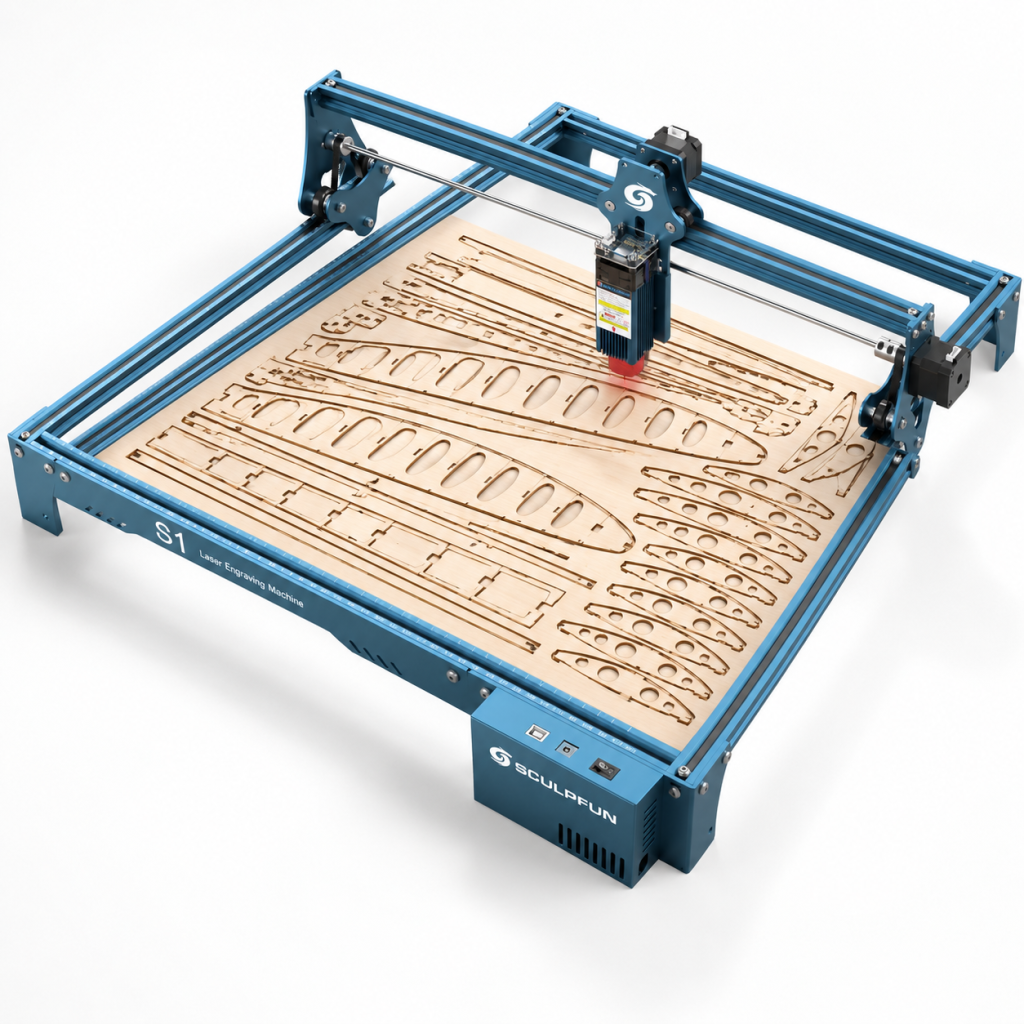
A diode laser cutter burns its way through material with a focused beam. It’s fantastic for flat sheet stock — balsa, thin plywood, foam board, and light ply doublers — and it can also just engrave lines onto wood, which is quietly one of the best features for a scratch builder. Instead of printing a paper template and tracing it onto balsa with a pencil (and slightly messing up the curve every time, ask me how I know), you can etch the rib outline straight onto the sheet and cut it in the same pass.
Wattage matters more than any spec sheet buzzword. A 10W diode will cut 1/16″–1/8″ balsa without much fuss, but you’ll be running multiple passes on anything approaching 1/4″ plywood. 20W and up gets you through thicker stock faster and with less charring on the edges. Past about 40W on a diode you’re getting into territory where the cost stops making sense for most scratch builders — that’s when people start looking at CO2 tubes instead, which is a whole different (and much pricier) conversation.
Bed size deserves its own paragraph, because it’s the thing people underestimate. If you build small park flyers, a compact 400x400mm bed is plenty. If you’re into scale warbirds or anything with a wing panel longer than about 20 inches, a small bed means cutting parts in sections and taping the pieces back together like a crime scene reconstruction. Measure your typical rib and panel lengths before you buy, not after.
Air assist — a stream of air blown right at the cut point — keeps flames down and dramatically reduces the black char you get on cut edges. Some machines build this in, others make you buy it separately. Either way, budget for it; it’s not optional if you care about your cut edges looking clean under covering film.
Enclosure is worth thinking about too. Open-frame lasers are cheaper and more common at the budget end, but an enclosed unit contains sparks, fumes, and stray reflections a lot better — genuinely nicer if you’re running this in a garage that also has your workbench, your dog, or your car parked six feet away.
And I’m not going to bury this in a footnote: every machine below is a Class 4 laser. Class 4 means it can blind you instantly and start a fire in scrap balsa dust without much encouragement. Treat it with the same respect you’d give a table saw, not a hot glue gun.
If you’re designing your own ribs and panels first, our free RC Wing Designer tool is basically the perfect front half of this workflow — design the airfoil digitally, export it, then let one of these machines cut it instead of eyeballing a printed template.
Best Diode Laser Cutters for RC Airplane Building
🥇 xTool D1 Pro 20W Laser Engraver (4-in-1 Rotary Kit Bundle)
This is the one I’d point a first-time buyer toward. The 20W module has enough bite to cut 1/8″ plywood in two or three passes and gets through balsa sheet almost embarrassingly fast. The compressed spot size keeps rib details crisp instead of that slightly-melted look you get from cheaper diodes. This particular bundle throws in a 4-in-1 rotary roller kit too, which is handy the day you decide to engrave a spinner or a dowel spar instead of just flat sheet. Software plays nicely with LightBurn, which honestly matters more than the hardware once you’re a few projects in.
Specs: 20W diode laser module, compressed spot size for fine detail cutting, default engraving area expandable with add-on rails, LightBurn and app compatible, bundled 4-in-1 rotary roller kit
Best for: First-time buyers wanting one machine that handles both balsa cutting and template engraving without a steep learning curve
Builder feedback: Most people landing on this one already own a 3D printer and wanted something that felt similarly “just works” — reports are it mostly delivers on that, once you’ve squared the gantry properly.
🥈 Sculpfun S30 Ultra 33W Laser Engraver
This is my actual pick for Best Overall, and the reason is the bed size as much as the power. A 600x600mm working area means most wing panels and full rib sets fit without splitting them into sections. The 33W module chews through 1/4″ plywood without much drama, and the automatic air assist is a genuinely nice touch — cleaner edges, less char, less sanding before covering.
Drawback, because I promised I’d give you those: the built-in air assist pump hums along like a shop vac having a minor existential crisis. It’s not unbearable, but don’t put this thing next to where you actually sit and build.
Specs: 33W laser module, 600x600mm working area (extendable), automatic air assist, replaceable lens design for easier maintenance
Best for: Builders cutting full-size wing panels, doublers, and larger fuselage formers in one go
Builder feedback: The bigger bed gets mentioned constantly as the reason people upgrade to this from a smaller diode laser — fewer joints to hide under covering film.
🥉 Ortur Laser Master 3 10W Laser Engraver
The honest budget pick. Ten watts is plenty for balsa and thin ply, the app control is straightforward, and the foldable-feet frame keeps the footprint reasonable on a crowded bench. It’s not going to blaze through 1/4″ plywood without patience, and the frame does flex a bit at higher speeds if you don’t take the time to square and tension it properly — which, to be fair, is true of every machine at this price point, not just this one.
Specs: 10W output, compressed spot size (~0.05 x 0.1mm), engraving speeds up to 20,000mm/min, app-controlled, Class 4 laser
Best for: Budget-conscious builders mainly cutting balsa sheet and engraving plan outlines rather than production-cutting thick plywood all day
Builder feedback: Common complaint is the frame needing a squaring check out of the box — five minutes with an actual square fixes most of it.
NEJE Max 4 E80 20W Laser Engraver with Rotary Attachment
The oddball pick, and I mean that as a compliment. It’s a genuinely large working area, the 20W module keeps pace with the xTool above, and it ships with a rotary attachment — which sounds like a gimmick until you realize it lets you engrave dowel spars, wheel pants, and spinners, things that are round and normally impossible to mark cleanly by hand.
The software is the weak link. NEJE’s own app is fine for basic jobs, but if you want the same polish as the LightBurn crowd, budget for that license separately — it’s a small extra cost that isn’t obvious until you’re already in the ecosystem.
Specs: 20W diode module, large extendable working area, bundled A-axis rotary attachment for cylindrical parts
Best for: Builders who also want to personalize or engrave round parts — spinners, dowel stock, wheel pants — not just flat sheet goods
Builder feedback: The rotary attachment gets more actual use than people expect going in; it’s the feature nobody buys this for and then everyone ends up using.
Creality Falcon2 22W Laser Engraver
Creality’s name recognition from the 3D printing side carries over here, and the Falcon2 is a solid mid-tier pick if you want integrated air assist without shopping for a separate pump. 25,000mm/min rated speed keeps production cutting reasonably quick, and build quality feels a notch above some of the smaller no-name diode frames.
It’s an open-frame design at this price point, not the enclosed Pro version, so you still want the same eye protection and fire precautions as anything else on this list — “integrated air assist” is not the same thing as “contained beam.”
Specs: 22W output, integrated air assist, 25,000mm/min cutting speed, compatible with wood, acrylic, leather
Best for: Builders who want a known-brand machine with air assist already sorted, without stepping up to an enclosed model
Builder feedback: Frequently mentioned as an easy step up for people already in Creality’s ecosystem from a 3D printer purchase.
Laser Safety Gear & Air Assist Accessories You Actually Need
Nobody wants to spend extra money right after buying the main machine, I get it. But skip this section at your own risk — literally, in the case of the safety glasses.
Comgrow Air Assist Pump Kit
A 30L/min adjustable air pump that blows a stream of air right at the cut point, which keeps flames down and noticeably reduces the black char on cut edges. Less char means less sanding before you cover the part, which is reason enough on its own. Worth grabbing if you went with the Ortur or the xTool above, since neither of those ships with air assist included.
Specs: 30L/min adjustable airflow, fits most diode laser heads, reduces soot and charring on cut edges
Best for: Anyone whose laser cutter didn’t come with air assist built in — cleaner cuts, less cleanup
Builder feedback: The main gripe is just finding bench space for one more box and one more hose, not the performance.
Laser Safety Glasses (405/445/450nm Diode Wavelengths)
Wear these. Every time. Yes, even for “just a quick engrave.” Every laser cutter listed above is a Class 4 device — that’s the same hazard class as industrial cutting lasers, and it can cause permanent eye damage before you’d even feel it happening. They’ll make you look like you’re doing at-home LASIK, and that’s a fair trade for keeping your eyesight.
Specs: Rated for common diode laser wavelengths (405/445/450nm) plus additional coverage for 532nm and 850nm sources
Best for: Literally every single laser cutter session, full stop
Builder feedback: The kind of purchase nobody’s excited about until the one time they need it.
Creality Smoke Purifier / Fume Extractor
Burning balsa and plywood smells kind of great for about the first ten minutes, then it gets old fast, and your garage (and whoever else lives in your house) will start noticing. A fume extractor with real filtration handles this properly instead of just moving the smell to a different room.
Specs: Multi-stage filtration, high claimed purification rate, connects via standard 3–3.5″ exhaust duct
Best for: Keeping the smoke, smell, and fine particulate out of your workshop air — and out of the argument about whether this hobby can stay in the garage
Builder feedback: Works best paired with an actual enclosure or hood around the cutting area — sitting a few feet away in open air, it does a lot less than you’d hope.
Laser Bed & Engraving Accessories
Creality Honeycomb Working Table (500x500mm)
An aluminum honeycomb bed that elevates your workpiece so the beam can actually cut all the way through instead of scorching your bench underneath. Also helps dissipate heat and gives you noticeably more even cuts on thin balsa and lite-ply sheet.
Specs: Aluminum honeycomb structure, 500x500mm, elevates workpiece for clean through-cuts, aids heat dissipation
Best for: Protecting your actual work surface and getting cleaner edge quality on thin sheet stock
Builder feedback: Adds a bit of height to your setup, so plan on rechecking your Z-focus after installing one — an easy step to forget the first time.
ORTUR Laser Rotary Roller Attachment
If you went with a laser above that doesn’t already bundle a rotary (the Sculpfun, the Falcon2, or the base Ortur), this is the accessory that unlocks engraving on round stock — dowel wing spars, wheel pants, aluminum spinners, fuel tubes. Diameter is adjustable and it plays reasonably well across brands, not just Ortur’s own machines.
Specs: 360° rotation, adjustable diameter range, broad cross-brand compatibility with most desktop laser engravers
Best for: Adding cylindrical engraving capability to a laser that didn’t come with one bundled
Builder feedback: A “why didn’t I buy this sooner” purchase for anyone doing scale detail work with round parts.
Comparison Table
| Machine | Power | Work Area | Best For |
|---|---|---|---|
| xTool D1 Pro 20W | 20W | Expandable, standard rail size | First laser cutter, all-around balsa/ply cutting |
| Sculpfun S30 Ultra 33W | 33W | 600 x 600mm | Full wing panels, larger sheet stock |
| Ortur Laser Master 3 10W | 10W | 400 x 400mm | Budget entry, balsa-focused cutting |
| NEJE Max 4 E80 20W | 20W | ~460 x 810mm (extendable) | Large sheets + rotary engraving on round parts |
| Creality Falcon2 22W | 22W | Standard open-frame rail size | Known-brand pick with integrated air assist |
Frequently Asked Questions
Can a laser cutter actually cut balsa and plywood, or does it just engrave?
It genuinely cuts, not just marks. A 10–20W diode laser will slice through balsa sheet in a single pass and gets through 1/8″ plywood in a couple of passes. Anything past about 1/4″ plywood or basswood starts taking real patience.
Should I get a laser cutter or a CNC router first?
If you’re mostly working in balsa and thin ply, start with a laser — it’s the more forgiving, faster entry point for flat sheet parts. If you’re regularly cutting thicker plywood, basswood, or need 3D-contoured parts like a carved cowl or leading edge, a CNC router is the better first purchase instead. I’ve written a full breakdown in the best CNC routers for RC airplane building guide if that sounds like you.
Are these diode lasers actually dangerous, or is that overblown?
They’re genuinely dangerous, not just a liability disclaimer. Class 4 lasers can cause permanent eye damage instantly and can ignite scrap balsa dust or shavings if left running unattended. Wear the safety glasses, keep flammable scrap clear of the work area, and don’t walk away mid-cut.
What size work area do I actually need for RC airplane parts?
It depends entirely on what you build. Small park flyers and foamies are fine on a compact 400 x 400mm bed. Anything with wing panels longer than about 20 inches gets a lot more practical with a 600 x 600mm bed — otherwise you’re cutting parts in sections and rejoining them.
Can these machines cut carbon fiber or fiberglass?
No — diode lasers don’t cut composites cleanly and the fumes from burning resin are not something you want to breathe. That’s a CNC router job, with the right bit and proper dust extraction.
Final Thoughts
Start with a laser if you’re mostly working in balsa and thin ply — it’s the more forgiving entry point, and honestly the one that’ll save you the most hours per dollar spent. My actual pick for most builders is the Sculpfun S30 Ultra for the bed size alone; the Ortur is the right call if you want to keep the budget down and don’t mind a smaller working area.
Whichever way you go, budget for the safety gear on day one, not after something goes wrong. It’s the least exciting purchase on this whole list and the one I’d least want you to skip.
Related Guides
- Best CNC Routers for RC Airplane Building — the companion guide for thicker material and 3D-contoured parts
- Best Balsa Wood for RC Airplanes — the material you’ll actually be feeding into most of these machines
- Essential Tools for Balsa Model Building — the hand-tool basics that still matter even once you own a laser
- Best 3D Printers for Printing RC Airplanes — the additive counterpart to everything on this page
- RC Wing Designer — Complete User Guide — design your rib profiles here first, then cut them with the gear above