
Some links in this article are affiliate links. As an Amazon Associate, rcplanediy.com earns from qualifying purchases at no extra cost to you.
⚡ Quick Picks at a Glance
- Best Premium Film (Balsa): Hangar 9 UltraCote White HANU870
- Best Budget Film: Oracover/Ultracote Generic 60cm × 200cm rolls
- Best Foam-Safe Film: Hangar 9 UltraCote Transparent HANU887
- Best Covering Iron: Hangar 9 Digital Sealing Iron HAN1017
- Best Trim Tape: Hangar 9 UltraStripe Black 1/4″
So you’ve spent a couple of weeks — maybe more if your workshop time is, let’s say, limited by the rest of life — building a nice balsa airframe. The ribs are straight, the spars are glued, and the whole thing looks pretty decent considering what it started out as. Now comes covering. This is where a lot of builders either make their plane look like a million bucks, or make it look like it was wrapped in a supermarket bag on a rainy Tuesday.
Covering film is one of those areas where brand choice and product selection actually matters a surprising amount. I’ve seen perfectly built balsa trainers come out looking rough because someone cheaped out on covering, and I’ve also seen mediocre builds look absolutely crisp because the covering job was clean. The film itself — its shrink behavior, how it bonds to wood, how well it behaves around curves — makes a real practical difference.
This guide covers all the main covering options actually available on Amazon right now: heat-shrink polyester films (MonoKote, UltraCote, and budget alternatives), foam-safe lightweight films, fabric coverings, trim tape, and the tools you’ll need to apply all of them. Whether you’re covering a 40″ balsa trainer or trying to add a colour scheme to a foam park flyer, there’s a right product here for you.
How RC Covering Film Works — and Why It Matters
All the main covering films work on the same basic principle: a thin polyester film with a heat-activated adhesive on one side. You iron it onto the framework at low heat (adhesion temperature), then use higher heat from an iron or heat gun to shrink it drum-tight. The result is a lightweight, fuel-resistant, waterproof skin that also adds meaningful structural rigidity to the airframe.
The differences between products come down to a few things. Adhesion temperature matters a lot — higher-temp films like MonoKote need real heat to bond, which makes them unsuitable for direct application to foam (it’ll melt). Shrink characteristics vary too: some films shrink a lot and snap tight over open-bay structures; others shrink minimally and are better suited to sheeted surfaces. Weight is a factor for small models — the lighter “ParkLite” and similar products save meaningful grams on 36″ wingspan planes. And of course, colour selection is a practical concern — you want the red and white for your trainer, not just “whatever happens to be in stock.”
One thing that trips people up: not all covering film is foam-safe. MonoKote is explicitly not for direct foam application. UltraCote and UltraCote Lite are more forgiving. If you’re covering a foamie, check the spec before you accidentally melt your wing.
What to Look For Before Buying
Know your substrate. Balsa or wood frameworks? Go with MonoKote or UltraCote standard. Foam sheeted surface? Use UltraCote Lite, UltraCote Transparent, or a low-temp generic film. Open bay foam? There’s not really a great iron-on option — spray paint or dope is more practical.
Buy enough for the job. A typical 6-foot MonoKote roll covers roughly a 40″ wingspan trainer’s main wing in one colour. Add a second colour for trim, and account for fuselage, stabs, and fin. Seriously, buy more than you think you need. Running short halfway through and having to order more is a special kind of frustration.
Colour matching trim. If you’re planning a two-colour scheme, buy trim tape in the same brand family as your main covering — Hangar 9 UltraTrim is designed to match UltraCote, and MonoKote Trim Sheets match MonoKote. Mix brands and the colours often don’t match, and the adhesion characteristics differ too.
Application temperature. Most brands publish the temps needed for adhesion and shrinking. UltraCote is a bit more forgiving with temperature than MonoKote. If you’re new to covering, UltraCote’s wider temperature window makes the learning curve a bit gentler.
Section 1 — Hangar 9 UltraCote: The Premium Standard
UltraCote from Hangar 9 (Horizon Hobby) has a strong following among builders who’ve switched from MonoKote and never looked back. The main practical advantage is the multi-temperature adhesive system — UltraCote has separate and clearly defined temperatures for adhesion (~200-220°F), shrink onset (~300°F), and maximum shrink (~350°F). This makes temperature management less guesswork, especially for newer builders. UltraCote also stretches more than MonoKote, which helps it conform around tight curves and compound shapes.
🥇 1. Hangar 9 UltraCote White — HANU870
The most versatile colour in the UltraCote range, and the one you’ll reach for most on any standard build. The White is sold through Horizon Hobby’s official Amazon storefront so you’re getting the genuine article, not a knock-off. At 0.30 oz/sq.ft it’s decently light, and the fuel-proof, waterproof formula holds up to both glow and gas models. The “permits repositioning” feature is genuinely useful when you’re trying to get a large panel to sit right before final adhesion — something MonoKote is a bit less forgiving about.
- Specs: 6′ × 26″ | High-tech polyester | 0.30 oz/sq.ft | Fuel and waterproof
- Best for: All balsa and wood models, base colour for multi-colour schemes
- Adhesion temp: 200-220°F | Shrink onset: 300°F | Max shrink: 350°F

2. Hangar 9 UltraCote True Red — HANU866
Red is one of those covering colours where the difference between a nice red and a washed-out orange-red is genuinely visible at 100 metres. UltraCote True Red is actually true — a proper primary red that photographs well and looks right in the air. For a classic red-and-white trainer scheme, this pairs perfectly with the White above. Both are in stock through Horizon Hobby on Amazon. No issues to report here — solid product, consistent colour through the whole roll.
- Specs: 6′ × 26″ | True Red | 0.30 oz/sq.ft | Fuel and waterproof
- Best for: Red scheme accents, all-red models, trim colour

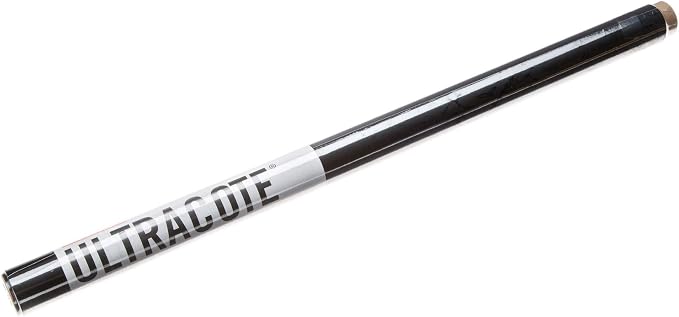
3. Hangar 9 UltraCote Black — HANU874
Black covering is slightly tricky because any slight wrinkle or uneven tension is extremely visible on a black surface. UltraCote’s Black holds up well here — the multi-temp system helps you get it tight. Good for accent panels, military markings, or the occasional all-black scheme if you’re into that sort of thing. One thing to watch: black covering gets noticeably hot in direct sun on the flight line. Probably not a big deal for most flying, but it’s worth knowing if you’re leaving the plane in the sun between flights.
- Specs: 6′ × 26″ | Black | 0.30 oz/sq.ft | Fuel and waterproof
- Best for: Accent panels, military schemes, scale markings
Section 2 — Foam-Safe Covering Film
Regular MonoKote and standard UltraCote aren’t suitable for direct application on foam surfaces — the adhesion temperature is high enough to damage or warp EPP and even denser foam materials. For foam models, you want either a specifically foam-safe film or UltraCote’s Transparent and Lite variants which use a lower-temperature adhesive system.
🥇 4. Hangar 9 UltraCote Transparent — HANU887
The Transparent covering is actually a really useful product beyond just being foam-safe. It adds a clear skin over sheeted foam surfaces without changing the colour underneath — useful for adding structural rigidity to a foam-covered balsa wing without committing to a paint colour. It’s also genuinely foam-safe at its lower adhesion temperatures. Reviewers use it for lightweight park flyers, indoor models, and as a protective clear coat over painted foam. The only complaint I’ve seen is that it’s a bit harder to see bubbles and wrinkles during application since it’s — well — transparent. Obvious in hindsight, but apparently catches people off guard.
- Specs: 6′ × 26″ | Transparent | Low-temp adhesion system | Foam-safe
- Best for: Sheeted foam models, park flyers, clear protective finish over paint

5. Oracover/Ultracote Generic — 60cm × 100cm (White)
Let’s be real here — if you’re covering a small foam park flyer or doing a patch repair on a budget model, you don’t necessarily need to spend MonoKote prices. This generic Oracover-compatible film comes in a fairly wide range of colours in the 60cm × 100cm size, which is plenty for accent work or small model coverage. The quality is honestly variable — some batches are fine, some have adhesive issues. Amazon reviews reflect this: it works for small jobs and budget builds, but I’d hesitate to cover a serious build with it.
The small roll size is both a feature and a frustration. Good for a single colour accent or partial cover on a small model. Not enough for a full trainer wing. Don’t buy six individual rolls expecting to cover a whole plane — you’ll be paying more per square metre than just buying a proper MonoKote roll.
- Specs: 60cm × 100cm per roll | Multiple colours available | Heat-shrink film
- Best for: Small repairs, accent colours on budget builds, testing colour schemes
- Drawbacks: Inconsistent quality between batches, small size not practical for full coverage
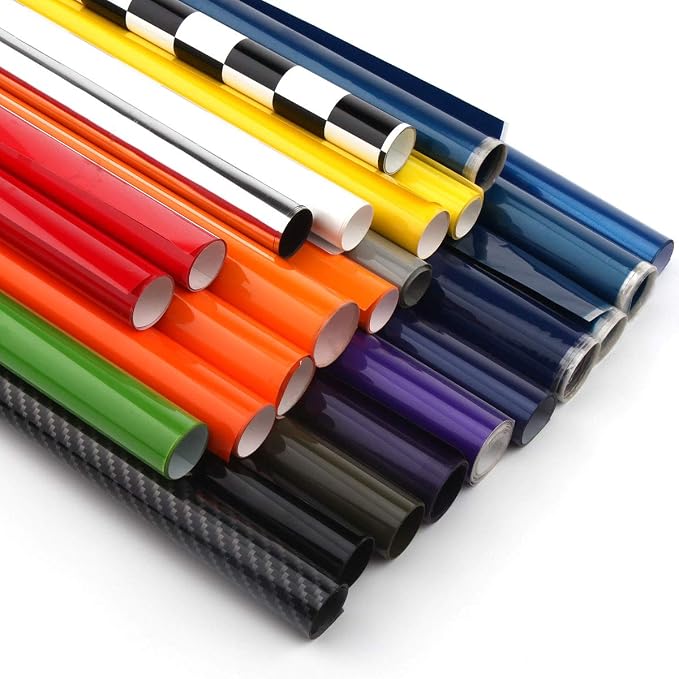
6. Oracover/Ultracote Generic — 60cm × 200cm Roll (Blue)
The 60cm × 200cm size (about 24″ × 79″) is more practical for actual wing coverage on smaller models up to about 40″ wingspan. Still in the generic “Oracover/Monokote/Ultracote” category of Chinese-manufactured film — not the real Oracover from Germany — but the larger roll size makes it more useful. The Dark Blue colour variant is well-reviewed for park flyers. Apply with moderate heat and don’t expect the same precision as name brands, and you’ll be fine.
- Specs: 60cm × 200cm | Multiple colours | Heat-shrink film
- Best for: Small to medium foam park flyers, budget builds under 40″ wingspan

Section 3 — Trim Tape & Striping
Once the main covering is on, trim tape is how you add the details — colour bands, fuselage accents, registration numbers, checker patterns. The peel-and-stick format means no iron required for application, though you can use low heat to tack it down more permanently on outdoor models.
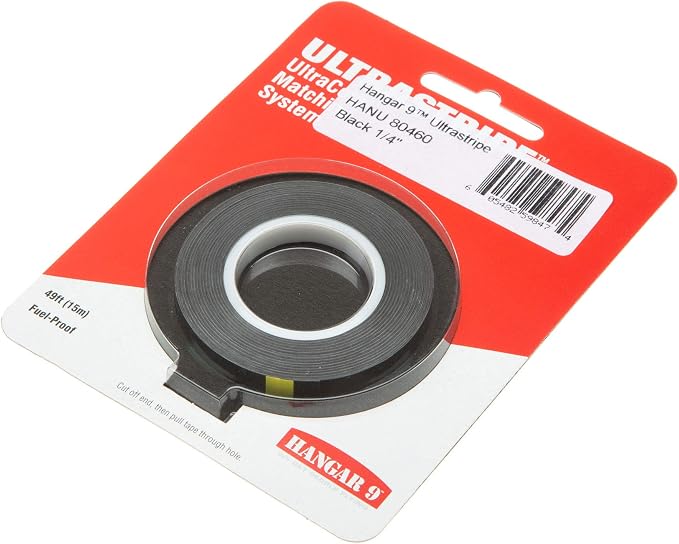
🥇 7. Hangar 9 UltraStripe Black 1/4″ — HANU80460
Black striping is probably the most-used trim product in RC building. Panel lines, canopy frames, pinstripes between two colours, outlined numbers — a thin black stripe does all of it, and it makes a red, yellow or white scheme look properly finished. UltraStripe is Hangar 9’s pre-cut striping tape from the UltraCote family, so it sits naturally alongside UltraCote colours. The 1/4″ width is the most versatile size: wide enough to read clearly in the air, narrow enough to follow curves around a canopy or cowl. Peel and stick it on, then tack it down with low heat on outdoor models for a more permanent bond.
- Specs: 1/4″ wide | Black | Peel-and-stick UltraCote-family striping
- Best for: Panel lines, pinstripes, canopy outlines, colour separation lines
Section 4 — Covering Tools
The covering is only as good as the tools used to apply it. A good sealing iron takes most of the frustration out of covering — a bad one (or worse, a domestic clothes iron) will burn through the film or fail to bond consistently. A heat gun is essential for shrinking large panels wrinkle-free.
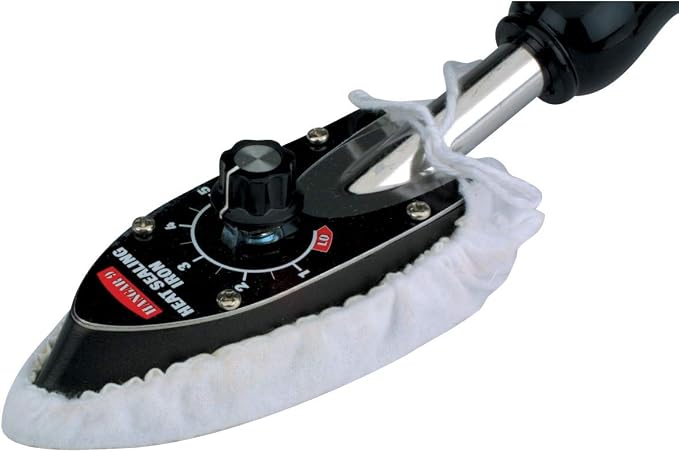
🥇 8. Hangar 9 Digital Sealing Iron — HAN1017
Hangar 9’s sealing irons have been the hobbyist covering benchmark for a long time, and this digital version is the current one to get. Precise digital temperature control with an LCD display holds heat consistently — which matters a lot because the difference between adhesion temp and shrink temp is only about 80-100°F, and imprecise temperature will either leave you with lifted edges or scorched film. You can switch the temperature units, the updated shoe shape makes it easier to get into corners, and the Teflon-coated shoe glides over film without scratching it. A metal stand and a sock come in the box, and there’s a three-hour auto shutoff for when you inevitably wander off mid-session.
It’s not the cheapest iron. Some builders balk at the price compared to generic irons. But covering a quality balsa build with a junk iron and ruining the film is the more expensive lesson. A proper iron pays for itself the first time it saves you from having to re-cover a wing panel.
- Specs: Digital temp control | LCD display | Teflon shoe | Stand + sock included | 3-hour auto shutoff
- Best for: Serious balsa builders, anyone doing regular covering work, film or fabric covering
- Drawbacks: Not the cheapest iron — budget builders may want to start with a simpler option

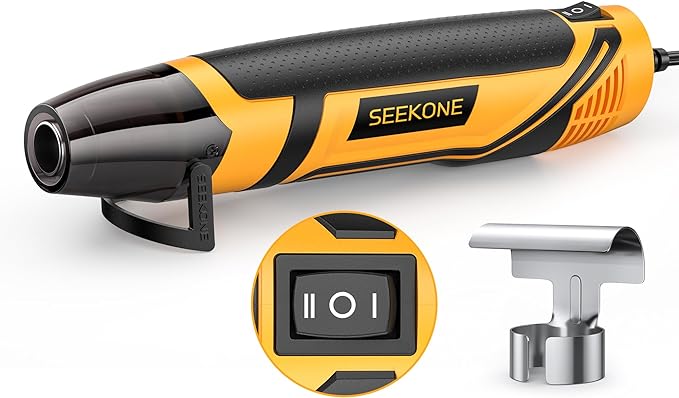
9. SEEKONE 350W Mini Heat Gun
The heat gun is what you use after the iron — once the covering is tacked and adhered to the framework, the heat gun shrinks it tight over the open bays between ribs. The SEEKONE mini has two settings, 500°F (260°C) and 842°F (450°C): the low setting is the one you’ll use for covering film, and the high one is there for heat-shrink tubing and other shop jobs. It’s compact and light, which matters when you’re working around a fuselage for half an hour, and it has built-in overheat protection. With nearly 10,000 reviews it’s one of the most-bought small heat guns on Amazon. Classic covering workflow: iron first for adhesion, heat gun second for final shrink. Skip the heat gun stage and you’ll end up with slightly saggy-looking covering that drives you a bit mad.
- Specs: 350W | 2 settings: 500°F / 842°F | Overheat protection | Nozzle included | Compact
- Best for: Final shrinking over open bays, removing minor wrinkles after adhesion
- Watch out: Keep it moving and stay on the low setting — 842°F will burn through film in a second
10. Hangar 9 Sealing Iron Sock — HAN141
This is one of those “you didn’t know you needed it” accessories. The sock slips over the shoe of your sealing iron and protects the covering while you work — it stops the iron from scratching or scuffing glossy film and lets it glide smoothly over seams and trim. Socks wear out and pick up adhesive residue over time, so it’s worth having a spare on the bench even though the Hangar 9 digital iron comes with one. Inexpensive and makes the whole covering process a bit less frustrating.
- Specs: Cotton sealing iron sock | Fits Hangar 9 sealing irons
- Best for: Protecting glossy film from scratches, smoother ironing over seams and trim
Quick Comparison Table
| Product | Type | Foam-Safe? | Best For |
|---|---|---|---|
| UltraCote White HANU870 | High-tech polyester | No | All balsa/wood models |
| UltraCote True Red HANU866 | High-tech polyester | No | Red colour schemes |
| UltraCote Black HANU874 | High-tech polyester | No | Accents, military schemes |
| UltraCote Transparent HANU887 | Low-temp polyester | Yes | Foam models, clear finish |
| Oracover Generic 60×100 White | Generic heat-shrink | Partial | Budget builds, small repairs |
| Oracover Generic 60×200 Blue | Generic heat-shrink | Partial | Small foam park flyers |
| UltraStripe Black 1/4″ | Peel-and-stick striping | Yes | Panel lines, pinstripes, accents |
| Hangar 9 Digital Sealing Iron HAN1017 | Covering iron | – | Serious builders, regular use |
| SEEKONE 350W Mini Heat Gun | Heat gun | – | Final shrinking, wrinkle removal |
| Hangar 9 Sealing Iron Sock | Iron accessory | – | Protecting film while ironing |
Frequently Asked Questions
Can I use MonoKote on a foam model?
Short answer: no, not directly on bare foam. MonoKote requires application temperatures (300°F+) that will melt EPP, EPO, and most foam materials. For foam models, use UltraCote Transparent or Lite, which have lower adhesion temperatures, or use the generic budget films which are generally more foam-tolerant (though not always). If you’re covering a foam model that’s sheeted with balsa or fibreglass, standard MonoKote is fine — the covering goes on the sheeting, not the foam.
How much covering do I need for a complete plane?
A rough guide for a 48″ wingspan balsa trainer: you’ll need approximately 2-3 rolls of 6-foot MonoKote or UltraCote in your main colour for the wings, plus 1 roll for the fuselage, tail, and fin. Add one roll of your accent colour for trim, and a few strips of trim tape. So budget for 3-4 rolls minimum, and buy 5 if you want a comfortable margin for mistakes. Nothing worse than running half a roll short on the final fuselage panel.
What temperature should I use for covering?
For UltraCote: adhesion starts at 200-220°F, shrinking begins around 300°F, maximum shrink is at 350°F. For MonoKote: adhesion around 275-300°F, shrinking at 325-350°F. The practical workflow is: iron at adhesion temp to tack the edges, then use a heat gun at higher temp to shrink the film flat over open bays. If you’re seeing the film yellow or blister, you’re running too hot.
MonoKote or UltraCote — which is actually better?
This is basically an RC forum religion war and I’m not going to solve it here. Practically speaking: MonoKote has slightly better puncture resistance and a more established colour range in flat finishes for scale modellers. UltraCote has a better temperature control system for beginners, stretches better around compound curves, and the trim tape family matches colours perfectly. For a first build, UltraCote is probably more forgiving. For serious warbird scale work, MonoKote’s flat finish range is hard to beat.
Do I need a special iron or can I use a clothes iron?
You can technically use a clothes iron in a pinch, but it’s genuinely not a good idea for serious work. Domestic irons have inconsistent temperature control, the wrong sole plate shape for getting into tight spots, and tend to either under-heat (film lifts in a week) or over-heat (burned through in seconds). A proper RC covering iron like the Hangar 9 Digital Sealing Iron isn’t a luxury purchase — it’s what makes the difference between covering that stays on and covering that peels off in the sun. Buy the right tool once rather than ruining covering film repeatedly.
Final Thoughts
For most builders the practical recommendation is this: if you’re building balsa and want professional results, go with Hangar 9 UltraCote as your main covering — the temperature system is more forgiving than MonoKote for anyone who isn’t already very experienced with a sealing iron. Get the Hangar 9 digital sealing iron to apply it properly. Add UltraStripe striping in a contrasting colour for the scheme, and keep a bottle of adhesive remover on hand for the inevitable mess.
If you’re a seasoned builder who’s been using MonoKote for twenty years and it’s working fine for you, there’s obviously no pressing reason to change. MonoKote is a genuinely excellent product. It’s just slightly less forgiving for newer coverers.
Budget option: the generic Oracover-compatible films work for foam park flyers and budget builds. Don’t expect MonoKote quality, but for a £20 foamie you’re not going to cover with premium film anyway.
Continue Reading — Related Guides
- 🔗 Best Balsa Wood for RC Airplanes — The structural material you’re about to put this covering over
- 🔗 Best Glue for RC Airplanes — CA, epoxy, and foam-safe adhesives for the build that comes before covering
- 🔗 RC Airplane Materials List — Full overview of everything that goes into an RC airplane build
- 🔗 Best RC Airplane Paint & Finishing Supplies — What to use when you want paint instead of (or on top of) covering film
As an Amazon Associate, rcplanediy.com earns from qualifying purchases at no extra cost to you. Prices and availability are subject to change — always verify on Amazon before purchasing.
3 Comments
Top 5 Websites for 3D Printable RC Airplane Plans - RC Plane DIY
[…] and painting is the way. Unlike balsa builds that use heat-shrink covering film (covered in our covering film guide), 3D printed planes need a sand-fill-prime-paint workflow. Our finishing supplies guide has the […]
Best RC Airplane Paint & Finishing Supplies: Paints, Primer & Decals - RC Plane DIY
[…] a heat-shrink film on a balsa frame, that’s a different job, and I’ve covered it in the covering film guide. Lots of builders mix both, by the way — film on the wings, paint on the fuselage and cowl. No […]
Best Covering Irons & Heat Guns for RC Airplanes: Complete Heat Tool Guide - RC Plane DIY
[…] less stressful. If you still need to pick the film itself, I’ve done that separately in my RC airplane covering film guide. This one assumes you’ve got a roll of UltraCote or Oracover on the bench and you’re […]