
Some links in this article are affiliate links. As an Amazon Associate, rcplanediy.com earns from qualifying purchases at no extra cost to you.
I’ve covered a fair few wings over the years, and I’ll be honest with you: the film is rarely the problem. It’s the heat. Too little and the edges lift two weeks later on a sunny field day. Too much and you’ve got a shiny hole where your trailing edge used to be. Most of the covering disasters I’ve seen at the club — mine included, especially mine — came down to a cheap iron with a dial that meant nothing, or a hardware-store heat gun pointed way too close for way too long.
So this guide is about the heat tools themselves. Sealing irons, the small irons for tight corners, heat guns for shrinking out the wrinkles, and the few boring accessories (sock, thermometer, a heat mat) that actually make the whole job less stressful. If you still need to pick the film itself, I’ve done that separately in my RC airplane covering film guide. This one assumes you’ve got a roll of UltraCote or Oracover on the bench and you’re wondering what to point at it.
Quick confession before we start: a few of the irons below are sold as “edge banding irons” for woodworking. Same tool, basically. A flat Teflon shoe on a handle with a thermostat. The RC-branded ones have mostly vanished from Amazon, and the woodworking versions are honestly fine — some of them even mention model covering on the box now. I’ll point out where they fall short.
Quick Picks
| Pick | Product | Why |
|---|---|---|
| Best Overall Iron | Hangar 9 Digital Sealing Iron | Real digital temperature control, stand and sock included, made for covering film |
| Best Budget Iron | O’SKOOL Digital Edge Banding Iron VL01 | Digital display, pointed shoe, does the same job for a lot less |
| Best Heat Gun | SEEKONE 1800W Variable Temp Heat Gun | Dial starts low enough for film, which most heat guns don’t |
| Best Cheap Upgrade | Etekcity 774 Infrared Thermometer | Finally find out what your iron dial actually means |
What to Look For in Covering Heat Tools
Temperature control you can trust. This is the whole game. Hangar 9 lists UltraCote as starting to stick to wood at about 200–220°F, starting to shrink around 300°F and hitting max shrink around 350°F. Oracover’s adhesive activates at roughly 100–120°C (212–248°F) and it wants more heat to shrink. Those windows aren’t huge. An iron with a vague “low – high” dial is guesswork; a digital readout (or at least a thermometer to check it) takes most of the drama out.
Shoe shape and coating. A Teflon (PTFE) coated shoe glides over film without scuffing it. A pointed or rounded tip gets into fillets and around the wing root. Bigger flat shoe for sheeted areas, small shoe for detail. Most people end up with one of each, sooner or later.
An iron and a heat gun are not the same job. The iron seals: edges, overlaps, anywhere the film touches structure. The heat gun shrinks: open bays between ribs, and compound curves on wingtips and fuselages where an iron just makes creases. You can shrink with an iron too, it’s just slower. You can’t really seal well with a heat gun.
Heat gun low setting. Most heat guns are built for paint stripping, so their “low” setting is still around 500–750°F. That works for film, but only if you keep moving and keep your distance. A gun with a variable dial that goes properly low is much more forgiving for a beginner. And for heat-shrink tubing on wiring, a small 350W mini gun is easier to aim.
Stand and cord. Boring, but a sealing iron without a proper stand will eventually melt something on your bench. Ask me how I know. A long cord matters more than you’d think once you’re working around a 60-inch wing.
Sealing Irons (Your Main Covering Tool)
The iron does 80% of the covering work. If you only buy one heat tool, buy one of these.
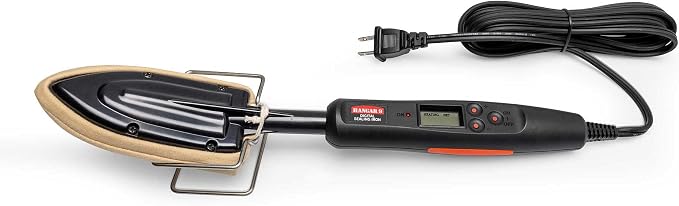
🥇 1. Hangar 9 Digital Sealing Iron (HAN1017)
This is the one I’d tell a friend to buy if he’s building more than one plane a year. Hangar 9 makes UltraCote, so this iron is pretty much designed around that film, and the digital temperature control means you set 220°F for sealing and you get roughly 220°F, not “somewhere between warm and lava”. The shoe is Teflon coated and the updated shape gets into corners better than the old analog Hangar 9 iron did.
It comes with a metal stand and a sock, which you’d buy anyway. There’s also a three-hour auto shutoff, which has saved my bench at least once. Downsides: it’s the priciest iron here by a margin, and the handle gets a bit warm on a long session. Not a dealbreaker, just a bit annoying for the money.
Specs: Digital temperature control with LCD, adjustable °F/°C, Teflon-coated shoe, metal stand and sock included, 3-hour safety shutoff
Best for: Builders who cover regularly and want a set-and-forget temperature
Builder feedback: The temperature readout is what people mention most — fewer burnt spots, fewer lifted edges.
🥈 2. O’SKOOL Digital Edge Banding Iron VL01
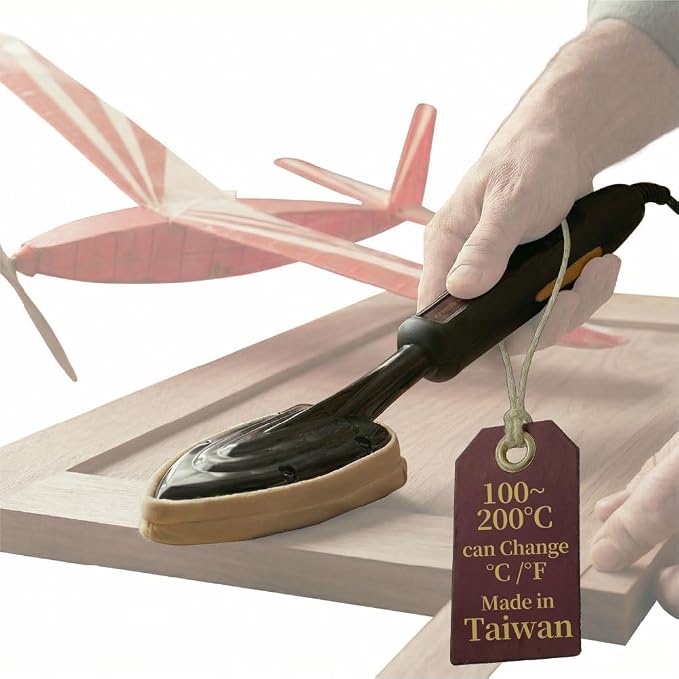
This is the “honest budget” pick. It’s sold for edge banding veneer but the listing actually calls out RC model covering, and the specs line up nicely: digital display, 212–392°F (100–200°C) range, PTFE shoe with a pointed tip for tight spots. That range covers UltraCote sealing and shrinking temps with room to spare.
It feels a bit lighter and more plasticky than the Hangar 9, and the stand is more of a basic rest than a proper cradle. I’d also check it with a thermometer the first time — budget thermostats tend to drift a few degrees. But for a first covering job, it’s hard to argue with.
Specs: Digital temperature display, 100–200°C (212–392°F), °C/°F switchable, PTFE-coated shoe with pointed tip, 110V
Best for: First-time coverers and anyone who doesn’t want to spend Hangar 9 money
Builder feedback: Plenty of RC builders in the reviews, mostly saying it does the job of the “proper” hobby irons.
3. Edge Banding Iron with LCD Display, Metal Stand & 3 Socks
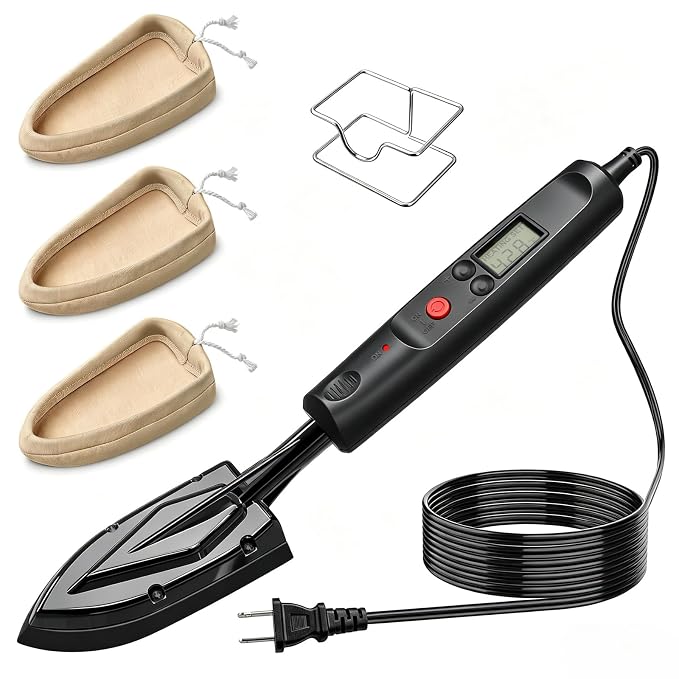
A generic-brand iron, but it’s got a big pile of reviews and it ships with three replacement socks, a metal stand and an 8-foot-plus cord, which is genuinely useful when you’re walking around a big wing. The range goes up to 428°F (220°C), a little higher than the O’SKOOL, so you’ve got headroom for films that like more heat.
The flip side: no-name brand, so quality control can be hit and miss, and the manual tells you to stop after four hours of continuous use and let it cool. Fine for a weekend session, but it tells you something about how hard you should push it.
Specs: LCD display, adjustable 212–428°F (100–220°C), metal stand, ~98-inch power cord, 3 cotton socks included
Best for: Budget builders covering larger models who want the long cord and spare socks
Builder feedback: Most-reviewed iron in this list; the extra socks and cord length get mentioned a lot.
Detail Iron for Tight Spots
A full-size sealing iron is clumsy around wing fillets, inside cockpit edges, around servo hatches, and for little trim pieces. This is where a small iron earns its spot on the bench.
4. Clover MCI-900 Mini Iron
This one comes from the quilting world, but RC builders have been nicking it for years. The head is tiny — think a big fingertip — on the end of a long, thin handle, so you can get into places a sealing iron just won’t fit. It comes with a stand that has rubber feet and a metal holder.
Not perfect for us though. There’s no digital readout, so you’ll want to check the settings with a thermometer once and remember where they land. And the head is small, so it’s slow for anything bigger than trim and corners. It’s a second iron, not a first one. Also stock has been a bit thin lately, so if you see it, don’t sit on it too long.
Specs: Mini shaped head, lightweight long handle, stand with rubber feet and metal holder
Best for: Fillets, cockpit edges, hatches, trim stripes and small repairs
Builder feedback: Thousands of reviews from quilters, and a cult following among scale builders for detail work.

Heat Guns for Shrinking Film (and Heat Shrink Tubing)
After the edges are sealed, the heat gun pulls the wrinkles out of open structure and lets film wrap compound curves. Keep it moving, keep it a few inches away, and sweep across the surface rather than blasting straight in. Trust me on that last one.
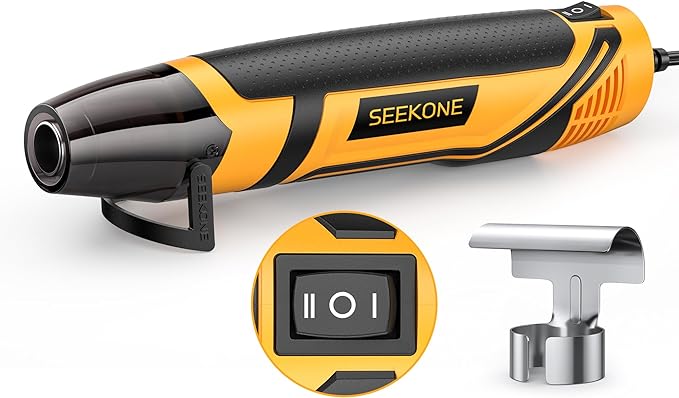
🥇 5. SEEKONE 1800W Heat Gun, Variable Temp 122–1202°F
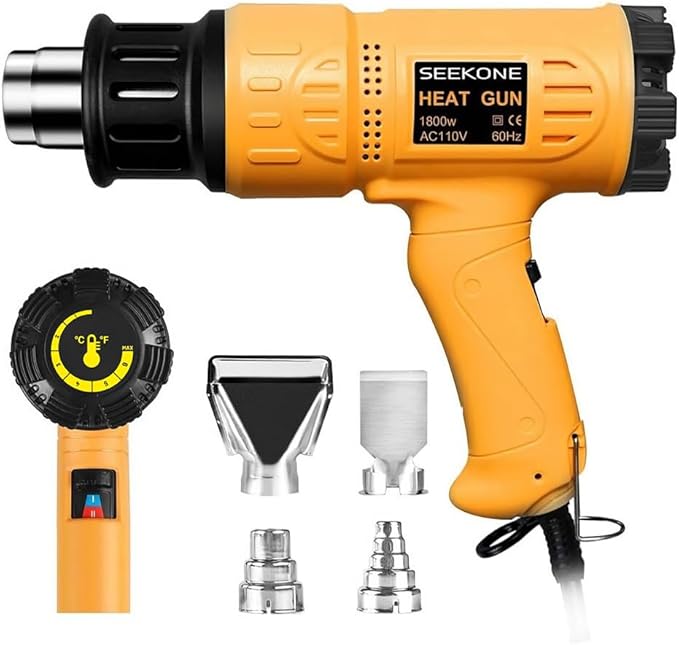
The reason this one’s my pick for covering: the dial goes properly low. Most heat guns have two settings, “hot” and “hotter”, and both are built for stripping paint. This SEEKONE has a variable dial starting around 122°F plus a separate high/low airflow switch, so you can sneak up on the shrink temperature instead of guessing. It also comes with four nozzles, and the reflector nozzle is handy for heat-shrink tubing.
It’s a full-size gun, so it’s a bit bulky for small park flyers, and 1800W at the top end will go through film fast if you get distracted. Use the dial. That’s the whole point of it.
Specs: 1800W, variable temperature 122–1202°F (50–650°C), two airflow settings, overheat protection, 4 nozzles
Best for: Shrinking film on any size model with real control over the heat
Builder feedback: One of the best-selling heat guns on Amazon; the low-temperature dial gets praised by crafters and modelers alike.
6. Wagner Spraytech HT1000 Dual-Temperature Heat Gun
The workhorse. Wagner is a big, proper brand and the HT1000 has been around forever. Two settings, 750°F and 1000°F, with two fan speeds. For covering you’ll live on the low setting and keep it moving — 750°F at the nozzle is a lot, but at four to six inches away and sweeping, it does a nice job of tightening film.
The lack of a variable dial is the drawback for our hobby. It’s less forgiving than the SEEKONE for a beginner, and you’ll burn through a corner at least once while learning. Pretty much everyone does. But it’s tough, simple and it’ll also do the paint stripping job around the house.
Specs: Dual temperature 750°F / 1000°F, two fan speeds, corded
Best for: Builders who also want a general shop heat gun and don’t mind keeping it moving
Builder feedback: Tens of thousands of reviews — it’s the heat gun a lot of us already have in the garage.

7. Genesis GHG1500A Dual Temperature Heat Gun Kit
Cheap, popular, and comes as a kit with four nozzles (two deflectors, a reflector and an air reduction nozzle). The listing even mentions warming up RC engines for easier starting, which made me smile — clearly someone at Genesis has been to a flying field. Low setting is 572°F, which is a bit kinder to film than the Wagner’s 750°F.
The rocker switch is just high/off/low, no fine tuning, and the build feels cheaper than the Wagner. For a budget gun that sits in the field box or covering drawer, it’s fine.
Specs: 1500W/750W, dual temperature 572°F / 1000°F, 4 nozzles included, 3-position rocker switch
Best for: Budget shrinking and general field use
Builder feedback: Very well reviewed for the price; the lower low-setting is a plus for film.

8. PORTER-CABLE PC1500HG Heat Gun
The middle ground. Porter-Cable gives you a variable temperature dial plus two fan speeds, and — the bit I like — an integrated stand so the gun can sit upright on the bench. That’s handy when you’re switching back and forth between iron and gun and don’t want to lay a hot nozzle down on your building board.
It costs a bit more than the SEEKONE and doesn’t come with the same nozzle bundle. Solid brand, solid tool, just not the cheapest way to get a dial.
Specs: 1500W, variable temperature dial, 2 fan speeds, integrated support stand
Best for: Builders who want a name-brand gun with variable heat and a hands-free stand
Builder feedback: Highly rated; the stand and dial are the usual reasons people pick it.

9. SEEKONE 350W Mini Heat Gun
Small, light (around 380 g), and with two settings of 500°F and 842°F. This one’s more for heat-shrink tubing on servo leads, ESC wires and battery connectors than for covering a full wing, but it’s also great for tightening film on small parts, control surfaces and little park flyers. Honestly, I reach for this one more than the big gun.
The airflow is low, so it’s slow on big panels, and you can’t fine tune it. It’s a detail tool. If you do your own wiring — and you should, see our ESC guide for what’s worth soldering — you’ll use it constantly.
Specs: 350W, two temperatures 500°F / 842°F, ~380 g, overheat protection, reflector nozzle
Best for: Heat-shrink tubing, small control surfaces, park flyers and touch-ups
Builder feedback: Thousands of reviews; electronics hobbyists love how easy it is to aim.
Accessories That Make Covering Easier
Cheap stuff, but this is what separates a smooth covering session from one where you’re scraping melted adhesive off the iron shoe.
10. Hangar 9 Sealing Iron Sock (HAN141)
A cotton sleeve that slips over the iron shoe. It stops the iron scratching the film, stops adhesive building up on the shoe, and spreads the heat a bit more gently. You’ll need to bump the temperature up slightly with a sock on, since it insulates a little. Socks wear out and get crusty, so keep a spare.
Fits the Hangar 9 irons nicely. On the edge banding irons it can be a little loose — not a big deal, but it can wrinkle at the tip.
Specs: Cotton sock for sealing iron shoe, designed for Hangar 9 irons
Best for: Protecting the film and the iron shoe on every covering job
Builder feedback: A must-have according to most reviewers; the only complaint is it eventually wears out.

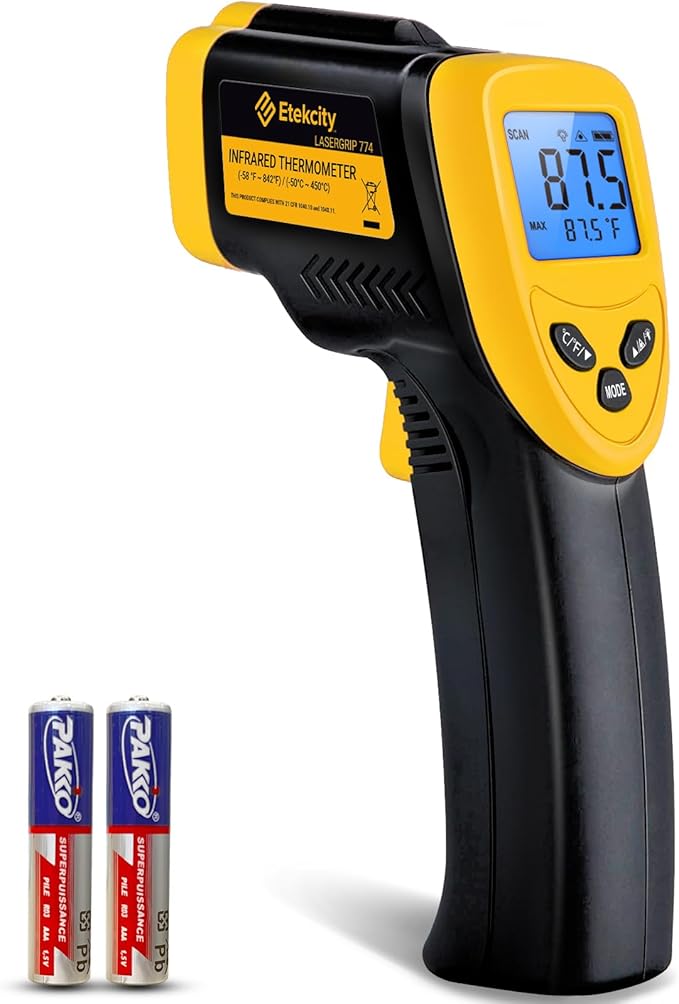
11. Etekcity 774 Infrared Thermometer
Here’s a slightly unexpected one. Point it at your iron shoe (or the film surface after a pass with the heat gun) and it tells you the actual temperature. That’s how you find out your “medium” setting is really 290°F, or that your sock knocks 30 degrees off. It’s the cheapest way to make a budget iron behave like a good one.
Shiny surfaces like a bare Teflon shoe can read low on IR thermometers, and the 774 has adjustable emissivity to help with that. Read the sock or film instead of the bare shoe for more realistic numbers. Also handy for checking motor and LiPo temps after a flight.
Specs: Infrared surface thermometer, 12:1 distance-to-spot ratio, adjustable emissivity, max display
Best for: Calibrating cheap irons and checking heat gun temps on film
Builder feedback: One of the best-selling IR thermometers on Amazon, used for everything from pizza ovens to motors.
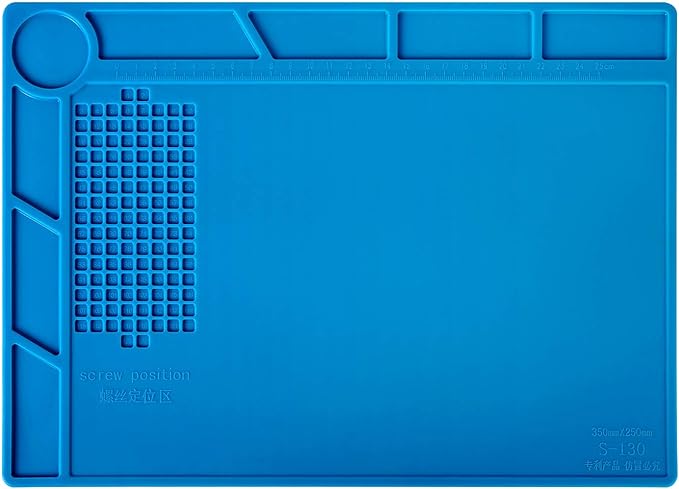
12. Kaisi S130 Silicone Heat-Resistant Work Mat
A silicone mat rated to 932°F. Drop it next to your building board and you’ve got a safe place to park the iron, the heat gun nozzle and the soldering iron without scorching the bench. It has a little ruler and screw compartments, which you’ll fill with tiny bits within a week.
At 13.8 x 9.8 inches it’s not big enough to work on a wing panel. It’s a parking spot and a small parts tray, not a covering surface.
Specs: Silicone, heat resistant to 932°F (500°C), 13.8 x 9.8 in, scale ruler and small-part slots
Best for: A safe resting spot for hot tools on a wooden bench
Builder feedback: Very highly rated; electronics repair folks swear by it.
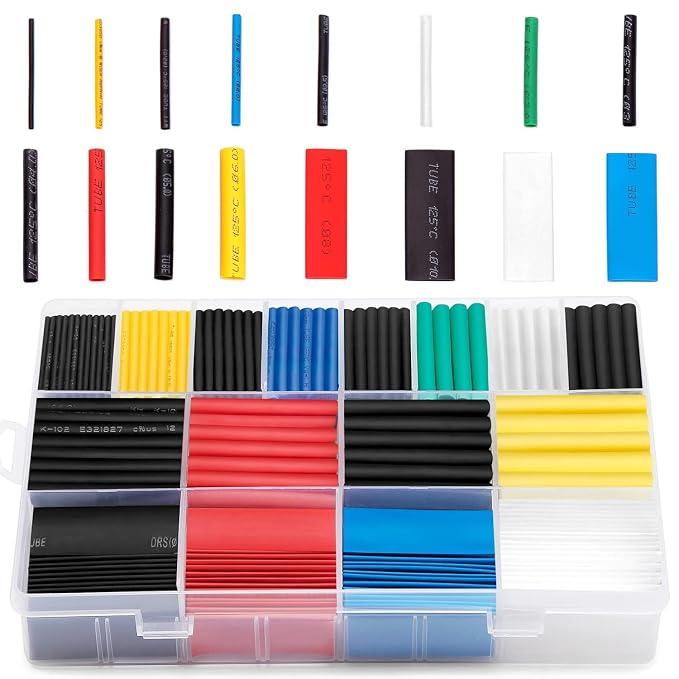
13. Ginsco 580-Piece Heat Shrink Tubing Kit
If you’ve bought a heat gun, you need something to shrink besides film. This kit has 580 pieces across 11 sizes and 6 colours, 2:1 shrink ratio. Small sizes for servo extensions and receiver leads, bigger ones for battery leads and ESC joints. The colours help keep positive and negative straight.
It’s basic 2:1 tubing without adhesive lining, so it’s not waterproof. For a plane that’s fine. The largest size will still be too small for the fattest battery leads on big models.
Specs: 580 pcs, 11 sizes from 1/24″ to 25/64″, 6 colours, 2:1 shrink ratio, storage case
Best for: Insulating solder joints on servo, ESC and battery wiring
Builder feedback: Huge number of reviews; the sorted case is the thing people like most.
Comparison Table
| Product | Type | Temperature Control | Best For |
|---|---|---|---|
| Hangar 9 Digital Sealing Iron | Sealing iron | Digital | Regular builders, UltraCote |
| O’SKOOL VL01 | Sealing iron | Digital, 212–392°F | Budget first iron |
| Edge Banding Iron w/ 3 Socks | Sealing iron | LCD, 212–428°F | Big models, long cord |
| Clover MCI-900 | Detail iron | Simple, no readout | Fillets, trim, hatches |
| SEEKONE 1800W | Heat gun | Variable 122–1202°F | Shrinking with control |
| Wagner HT1000 | Heat gun | 750 / 1000°F | All-round shop gun |
| Genesis GHG1500A | Heat gun | 572 / 1000°F | Budget shrinking |
| Porter-Cable PC1500HG | Heat gun | Variable dial | Name brand, built-in stand |
| SEEKONE 350W Mini | Mini heat gun | 500 / 842°F | Heat shrink tubing, small parts |
| Hangar 9 Iron Sock | Accessory | — | Protecting film and shoe |
| Etekcity 774 | Thermometer | — | Calibrating your iron |
| Kaisi S130 Mat | Accessory | — | Parking hot tools |
| Ginsco Heat Shrink Kit | Consumable | — | Wiring |
FAQ
Do I need both a covering iron and a heat gun?
Ideally yes. The iron seals edges and anywhere the film touches structure; the heat gun shrinks film over open bays and around compound curves. You can do the whole job with just an iron if you’re patient, but you can’t really do it with just a heat gun. If you’re buying one, buy the iron first.
What temperature should I set my covering iron to?
Follow the film maker’s numbers. Hangar 9 lists UltraCote as sticking to wood around 200–220°F, starting to shrink around 300°F and reaching max shrink around 350°F. Oracover’s adhesive activates at roughly 100–120°C (212–248°F). Add a little if you’re using a sock, and test on a scrap first.
Can I use a clothes iron to cover an RC plane?
You can, for a first try, but it’s awkward. Clothes irons are big, heavy, have steam holes in the base and their temperature markings aren’t made for film. A dedicated sealing iron or an edge banding iron is cheap enough that it’s not worth the frustration.
Are edge banding irons OK for RC covering?
Yes. They’re the same basic tool — a heated, PTFE-coated shoe with a thermostat — and several are now marketed for model covering too. Check the temperature range reaches at least 350°F (about 180°C) and check the real temperature with a thermometer the first time.
Why does my covering wrinkle again after flying in the sun?
Usually the film wasn’t fully shrunk, or the edges weren’t sealed well enough and it’s lifting. Go over it again with the heat gun and re-seal the edges with the iron. Leaving a model in a hot car will do it too, which I’ve learned more than once.
Final Thoughts
If you want the short version: get a digital sealing iron (the Hangar 9 if you cover a lot, the O’SKOOL if you’re starting out), a sock, and a heat gun with a low enough setting that you aren’t fighting it. Add the Clover mini iron when you get fed up trying to get a big shoe into a wing fillet. And grab an IR thermometer, because it turns “I think it’s hot enough” into an actual number.
Good heat tools won’t make you a covering artist overnight, but they take away most of the reasons it goes wrong. The rest is practice, and a few scraps of film you don’t mind ruining. Iron out the kinks in your technique on those first. (Yes, I know. I warned you about the puns.)
Want to go deeper on irons specifically — trim irons, socks and how to choose shoe size? See my guide to the best covering irons for RC airplanes.
Related Guides
- Best Covering Irons for RC Airplanes — sealing irons, mini irons and socks in more detail
- Best RC Airplane Covering Film & Materials — UltraCote, Oracover and trim tape
- Best Balsa Wood for RC Airplanes — the structure you’ll be covering
- Best Glue for RC Airplanes — get the airframe solid before the film goes on
- Best RC Airplane Paint & Finishing Supplies — decals and paint after covering
- RC Airplane Wing Designer — design the wing before you build and cover it
One Comment
Best Covering Irons for RC Airplanes: Sealing Irons, Mini Irons & Iron Socks - RC Plane DIY
[…] A proper covering iron changes that. Not because it’s magic, but because it gives you a temperature you can actually control and a shoe shape that fits where you need it. This guide is just about irons — the full-size sealing irons, the small detail irons, and the socks and bits that go with them. If you want the wider picture with heat guns as well, that’s in my covering irons & heat guns guide. […]